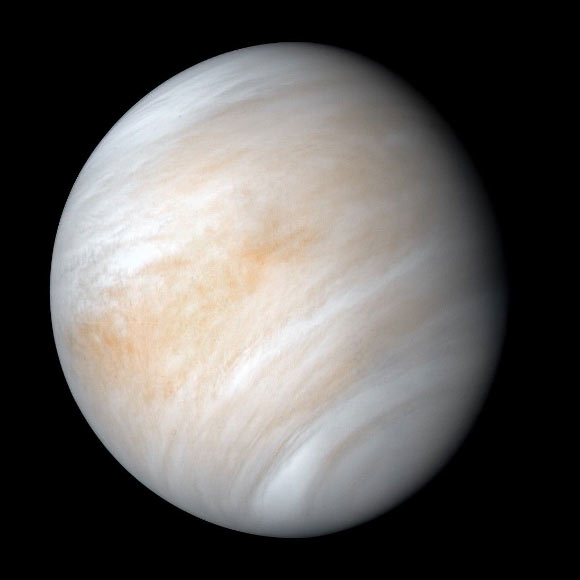
Dr. Stephen Kane and colleagues from the University of California, Riverside have provided an explanation for why Venus, similar to Earth in size and mass, lacks a moon.
Read More
Their study indicates that Venus's gravitational characteristics and its rotation rate played crucial roles in this phenomenon. Dr. Kane noted that Venus did not require a catastrophic event to reach its current state, revealing that the planet's gravity, combined with its spin rate, likely led to the collapse of any potential moon.
The researchers utilized computer simulations to analyze the orbital evolution of a hypothetical moon around Venus under gravitational tides. They found that the survival of such a moon greatly depended on Venus’s rate of spin following its formation. If a significant impact caused Venus to rotate quickly, with a day lasting less than approximately 12 hours, a lunar-sized satellite could have persisted for billions of years. Conversely, a slower spin would have resulted in tidal forces dragging any moon inward, causing it to be torn apart by Venus's gravity within a timeframe of roughly 30 million to 1.7 billion years.
Kane and his team examined two different models for how Venus’s rocky interior dissipates tidal energy. The results showed agreement at slower spin rates, but diverged for more massive moons at faster spins, highlighting the significant influence of Venus's interior properties on these outcomes.
Their findings connected to prior simulations of giant impacts suggest that those capable of causing Venus's slow retrograde rotation likely created debris disks that either fell back onto the planet or left a moon situated near the threshold of tidal survival. This implies that Venus's moonless condition does not necessitate a later catastrophic event to strip away an existing moon. Instead, it appears that standard tidal evolution following a sole giant impact could explain its situation.
The implications of this research extend to similar exoplanets orbiting close to their stars, suggesting they may struggle to maintain large moons, which could affect their climate stability. Dr. Kane remarked on the potential advantages of having a moon but stated that it is not essential for habitability. He noted that while Earth’s moon has significantly influenced its evolution, the precise importance of that role remains uncertain.
Kane concluded that slowly rotating planets may face the risk of their moons spiraling inward, fundamentally altering their development. His findings prompt further questions regarding Earth-like planets around other stars and their moon formations, revealing a troubling possibility for many such worlds: if they do not rotate swiftly, any moons could crash to their surfaces, dramatically affecting their histories.
The study was published in the Astrophysical Journal.