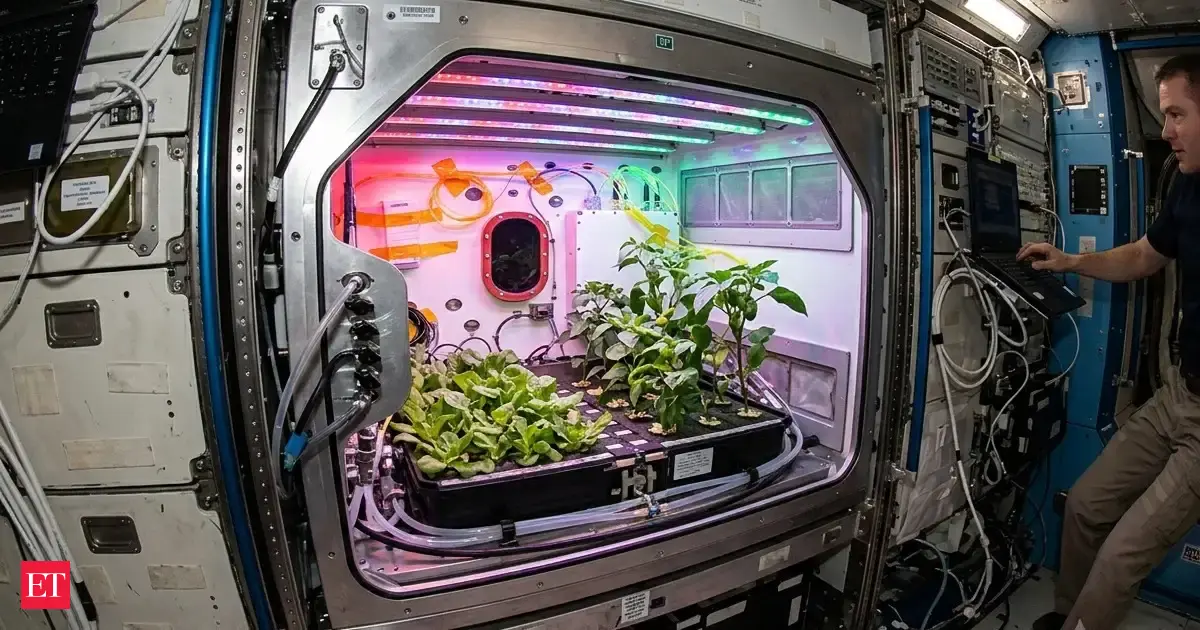
NASA's Advanced Plant Habitat (APH), a fully automated facility for plant bioscience research, was launched to the International Space Station (ISS) on April 18, 2017. Located in the Japanese Experiment Module Kibo, the APH is the largest facility of its kind on the ISS and allows scientists to study plant growth in a controlled microgravity environment with minimal crew involvement.
Read More
The APH is designed to investigate plant biology in microgravity, where the absence of gravity gives researchers the opportunity to explore how plants respond to altered environmental conditions. This research is crucial for future long-duration missions to the Moon and Mars, as astronauts will need reliable food production systems that are independent of regular resupply from Earth. Moreover, plants could play vital roles in oxygen production and water recycling on such missions.
NASA developed the APH alongside the Veggie facility for larger-scale plant research, which enables comprehensive studies on crop production and plant interactions. It operates as a closed-loop life-support system, maintaining controlled conditions for experiments lasting up to 135 days. Equipped with over 180 sensors capable of monitoring temperature, humidity, carbon dioxide levels, light intensity, and more, the facility allows data collection and environmental adjustments to be managed remotely from Earth.
Research conducted using the APH includes various investigations aiming to understand plant metabolism, genetics, and responses to microgravity. Notable experiments include:
- **Plant Habitat-01**: Compared growth between plants in space and those on Earth.
- **Plant Habitat-02**: Focused on radishes, analyzing their metabolic responses and characteristics.
- **Plant Habitat-03**: Investigated epigenetic changes in plants due to the spaceflight environment.
- **Plant Habitat-04**: Studied the growth of New Mexico Hatch green chile peppers in microgravity.
- **Plant Habitat-06**: Examined the defense responses in tomatoes after activating their defense systems.
The insights gained from the APH not only have implications for future space missions but also contribute valuable information for improving agriculture on Earth. Findings may enhance understanding of crop yields, flavor, and cultivation methods under controlled conditions.
After years of providing critical plant research data aboard the ISS, the APH is set to return to Earth in 2026, where it will be displayed in a museum, showcasing its significant contribution to space plant research. Over its operational lifespan, the APH has examined multiple plant species and a variety of aspects regarding plant life in space, from genetics and photosynthesis to plant defense mechanisms, enriching the understanding of how plants can thrive beyond Earth.