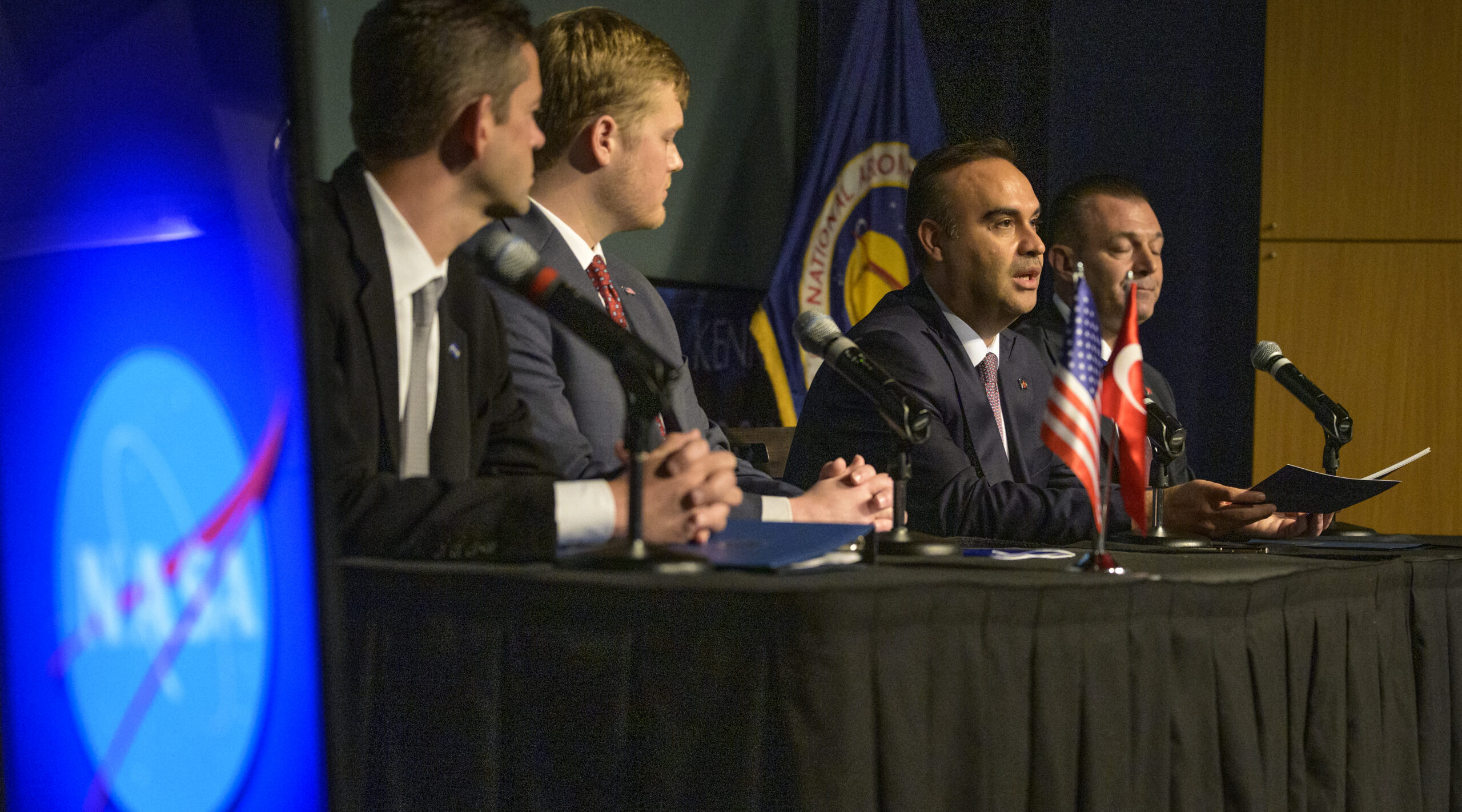
Türkiye signed the US-led Artemis Accords on 31 August, marking its status as the 71st country to join the initiative. This decision coincides with the testing phase of Türkiye’s first domestically developed lunar spacecraft, AYAP-1, which emphasizes Ankara's strategy of enhancing its sovereign capabilities through international cooperation without being confined to a single geopolitical alliance.
Read More
Industry and Technology Minister Mehmet Fatih Kacır announced that production, assembly, and integration of AYAP-1 have been completed, and the spacecraft has entered environmental testing ahead of its planned launch in early 2027. Kacır stated that over 80 percent of AYAP-1 is developed and produced domestically, including its software and hybrid propulsion system.
The signing of the Artemis Accords does not obligate Türkiye to participate directly in NASA’s lunar missions, and Ankara is concurrently building its own path to the Moon. The Accords allow countries to engage with non-signatories, and Türkiye has not indicated that its involvement with Artemis will limit other partnerships. The future impact of such collaborations on states that prioritize strategic autonomy remains an open question.
Türkiye perceives potential benefits from the Accords, including standards for technical cooperation and opportunities for scientific engagement, while it continues to focus on localization and developing its own space program. NASA has made participation in the Artemis program attractive by offering opportunities for partners to contribute to initiatives like the Moon Base through various capabilities.
During the signing event, Ankara framed its participation as a commitment to principles of transparency, data sharing, and interoperability, stressing that the Accords serve to bolster Türkiye's National Space Programme rather than replace it. This approach mirrors Ankara's broader foreign policy aimed at balancing relations with both Western and Eastern powers.
President Recep Tayyip Erdoğan, shortly after the signing, reinforced this multi-directional diplomatic strategy, asserting that Türkiye could strengthen ties with nations in the Shanghai Cooperation Organisation while maintaining its connections with the West.
Türkiye has not aligned itself with the China-Russia-led International Lunar Research Station and has emphasized its commitment to developing its independent lunar capabilities. AYAP-1 is planned to reach a polar lunar orbit, conduct scientific observations, and use its hybrid propulsion system to land on the lunar surface, with Kacır highlighting the mission as essential for Türkiye’s strategic independence.
Additionally, Türkiye is developing a domestic space ecosystem involving the Turkish Space Agency and related organizations, along with plans for a spaceport in Somalia to enhance its access to space and contribute to the global space economy.
The Artemis Accords, established in 2020 to promote peaceful lunar exploration, currently involve 72 signatories with varying degrees of alignment with US interests. This situation makes Türkiye a critical case for assessing the flexibility of the Artemis framework.
For Australia, which is invested in the Artemis initiative, the evolution of the Accords is significant. Ensuring they remain appealing to partners with diverse foreign policies is crucial. If Artemis becomes a tool of US geopolitical strategy, countries like Türkiye may seek to retain their autonomy.
Overall, Türkiye's involvement in the Artemis Accords reflects its view of space as a domain for expanding national capabilities through international partnerships, while emphasizing the importance of retaining control over its developmental processes.