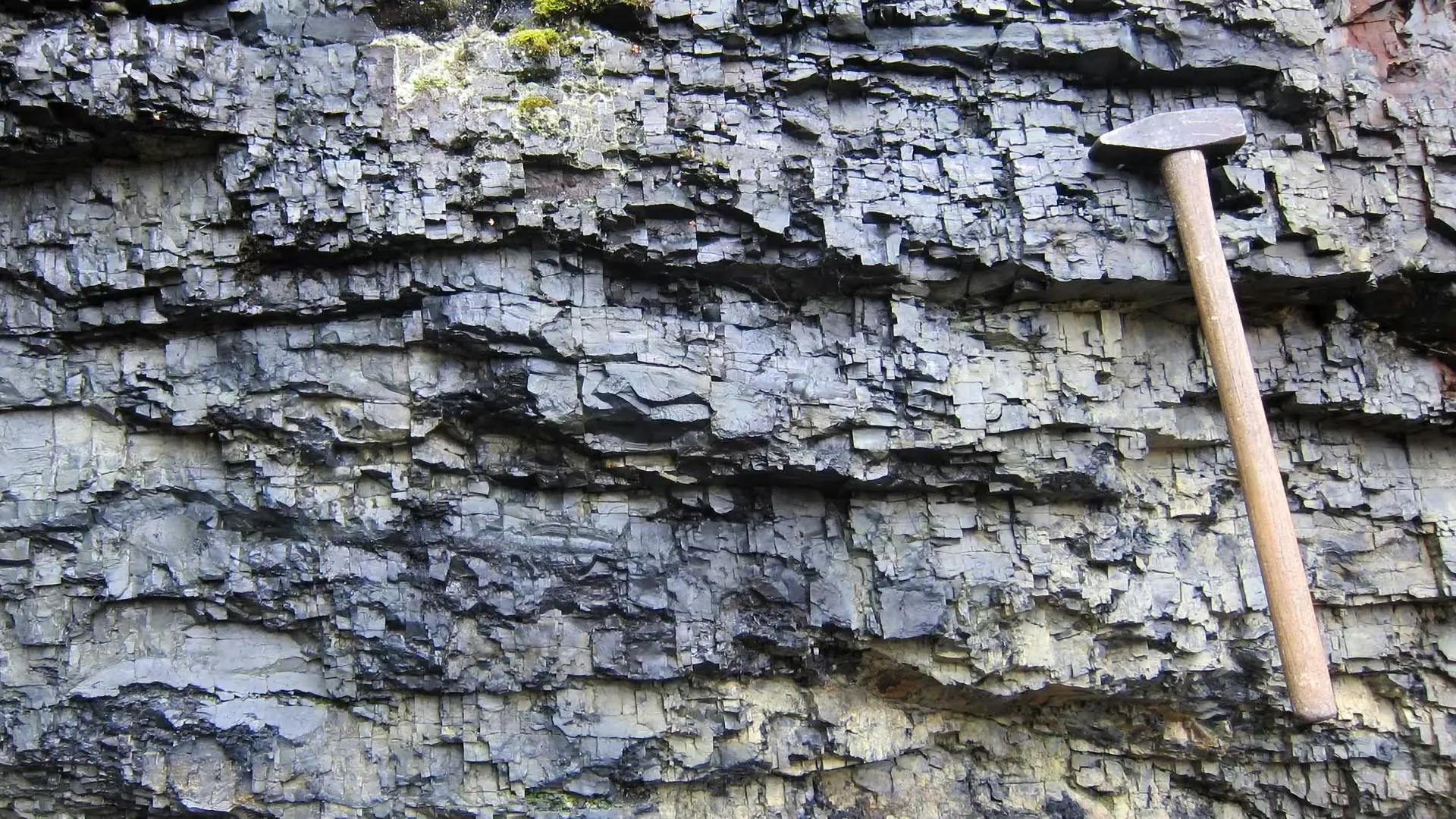
Earth experienced a significant chemical transformation between 2.5 and 2 billion years ago, leading to the accumulation of oxygen in the atmosphere. This shift played a crucial role in the eventual emergence of complex life forms approximately 500 million years later. During this period, vast amounts of microbial material were buried beneath the ocean floor, trapping carbon in sedimentary rocks and resulting in a specific isotopic signature.
Read More
For decades, many scientists interpreted this carbon isotopic signal as evidence of a major disruption in Earth's carbon cycle on a global scale. This interpretation was supported by drill cores obtained from ancient marine sediments in Karelia, Russia, and the Francevillian Basin in Gabon. However, a new study from Caltech researchers suggests that the evidence from Karelia may not reflect a worldwide event.
Nivedita Thiagarajan, a senior scientific researcher at Caltech, explained that the study investigated gases trapped within microscopic pockets in rocks from the Zaonega Formation in Karelia. These deposits, among the oldest known fossil oil fields, revealed that the carbon isotopic signal could be attributed to local geological phenomena rather than a global environmental change.
The study, published in Geology, outlines the process whereby researchers reconstructed changes in the Zaonega rocks after the first significant rise in atmospheric oxygen. Carbon isotopes, which are heavier or lighter forms of carbon, help scientists trace ancient biological material accumulation. By analyzing the ratio of these isotopes in drill cores, researchers can create records of past environmental changes akin to analyzing tree growth rings.
One of the key features of the research is the Shunga-Francevillian event, an anomalous carbon signal observed in both the Zaonega Formation and Gabonese rocks, previously interpreted as evidence of a global carbon cycle disruption. Aivo Lepland of the Geological Survey of Norway highlighted the importance of studying the rocks to understand the events surrounding Earth's oxygenation.
The research team analyzed drill cores from the Zaonega Formation, focusing on gases trapped in fluid inclusions rich in pyrobitumen. This material forms when crude oil or kerogen is subjected to intense heat beneath the Earth's surface. During the study, Thiagarajan collaborated with Lepland, who brought new isotopic measurements to Caltech, leading to a comprehensive interpretation of the ancient signals.
The researchers proposed that a magma intrusion disturbed the marine sediments at Zaonega, heating the organic material and generating hydrocarbons such as methane and propane. These gases migrated upward and were utilized by microbes near the seafloor, resulting in a light carbon isotopic signature embedded in the rocks.
Temperature measurements supported this scenario, indicating high thermal gradients near the magma intrusion. Thiagarajan noted that the processes identified could explain the carbon isotope anomaly observed at Zaonega, suggesting the presence of similar signatures in modern oil and gas reservoirs.
While the team acknowledged other potential contributing factors, their findings suggest that the carbon isotopic anomaly primarily originated from local sedimentary processes rather than a global event. This raises significant questions about whether the Shunga-Francevillian event should be recognized as a worldwide occurrence.
The next phase of the research involves examining whether the same localized processes can explain similar isotopic signals found in Gabon. Researchers plan to analyze samples collected as part of the GOE-DEEP project, co-funded by the International Continental Scientific Drilling Program. In 2025, Lepland coordinated the drilling activities in Gabon, and newly recovered cores are set to further investigate this hypothesis.
The study entitled "Paleoproterozoic thermogenic hydrocarbon generation, Zaonega Formation, Russia" includes contributions from Florian Eichinger of Hydroisotop GmbH and Anthony Prave of the University of St. Andrews.