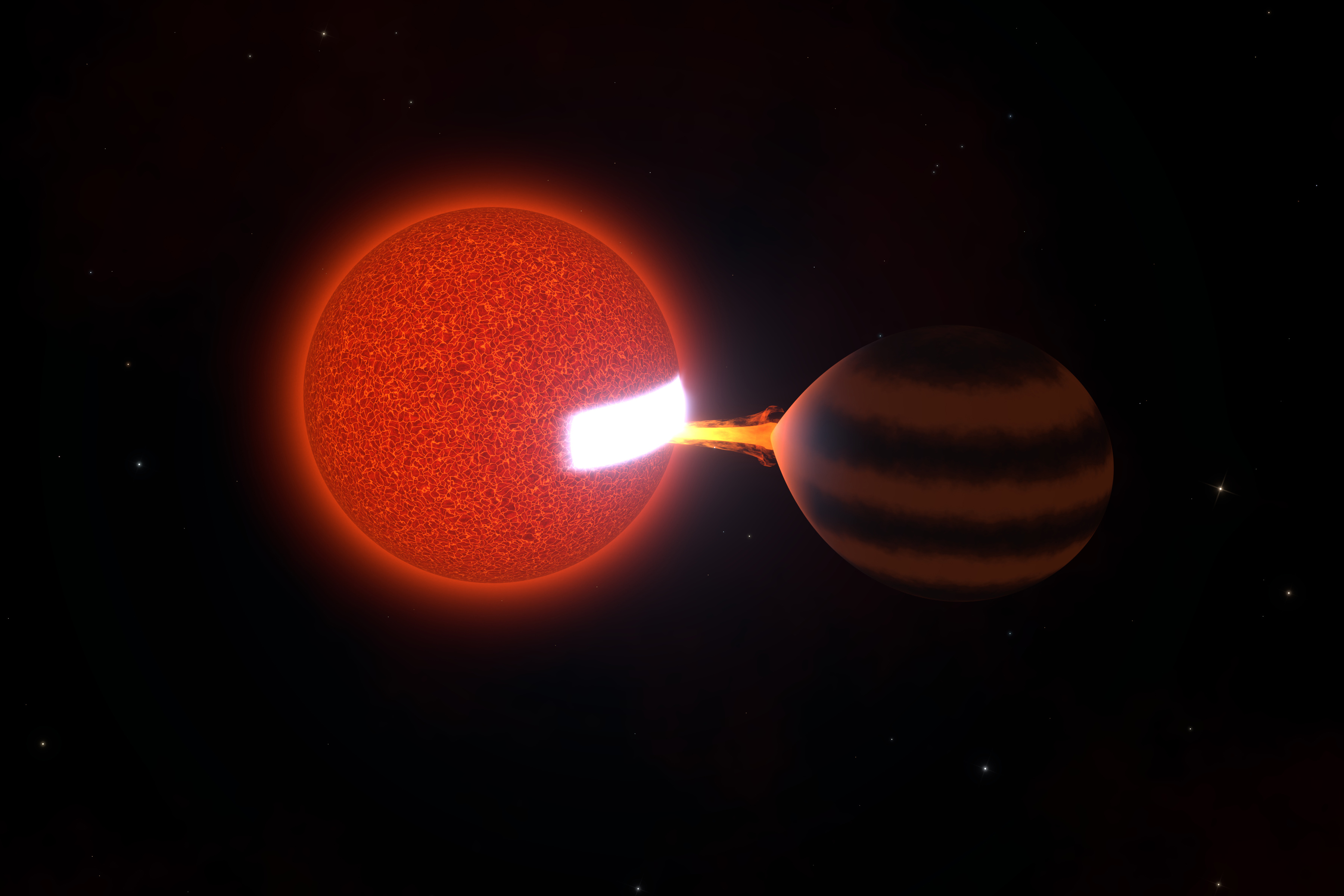
Astronomers have found a unique system where a star is gradually consuming material from a brown dwarf, a planet-like object larger than a planet but smaller than a star. This discovery, detailed in a study published in Nature Astronomy, occurs in the Milky Way galaxy, approximately 300 light years from Earth, and is the first instance of a low-mass star interacting with a similarly low-mass brown dwarf in this manner.
Read More
The star and brown dwarf, named ZTF J0440+2325, are remarkably close, with the brown dwarf completing an orbit every 87 minutes. The mass of the star is about 85 times that of Jupiter, while the brown dwarf weighs around 25 times as much. Unlike the more dramatic interactions seen between massive stars and smaller companions, the star in this system appears to be slowly accreting material from the brown dwarf, a process typically associated with black holes.
Kevin Burdge, an assistant professor of physics at MIT, highlighted that stars are generally perceived to eventually swallow their companions rather than consume them gradually. This discovery redefines that understanding. The star in ZTF J0440+2325 is drawing in material at a slow rate of about 1/100,000 of an Earth’s mass annually, akin to 40 million dump trucks’ worth or approximately 1.3 trillion one-pound burritos each second, though this is a minimal fraction of the brown dwarf's overall mass.
The peculiar light curve observed, resembling a triangle, was first detected by the Zwicky Transient Facility. Burdge and graduate student Aaron Householder were intrigued by this unusual signal, which did not fit the typical patterns seen from supernovae or black widow binaries. Upon further investigation, they determined the source of the signal and established its identity.
Simulations conducted by the team confirmed that particles from the brown dwarf indeed fell onto the star, marking the first observation of such an accretion process between low-mass objects. This incremental feeding process could potentially continue for billions of years, challenging the typical narrative of stellar interactions.
As researchers continue to explore similar systems, there is optimism about discovering more examples of this slow accreting behavior. The study was supported by the National Science Foundation.