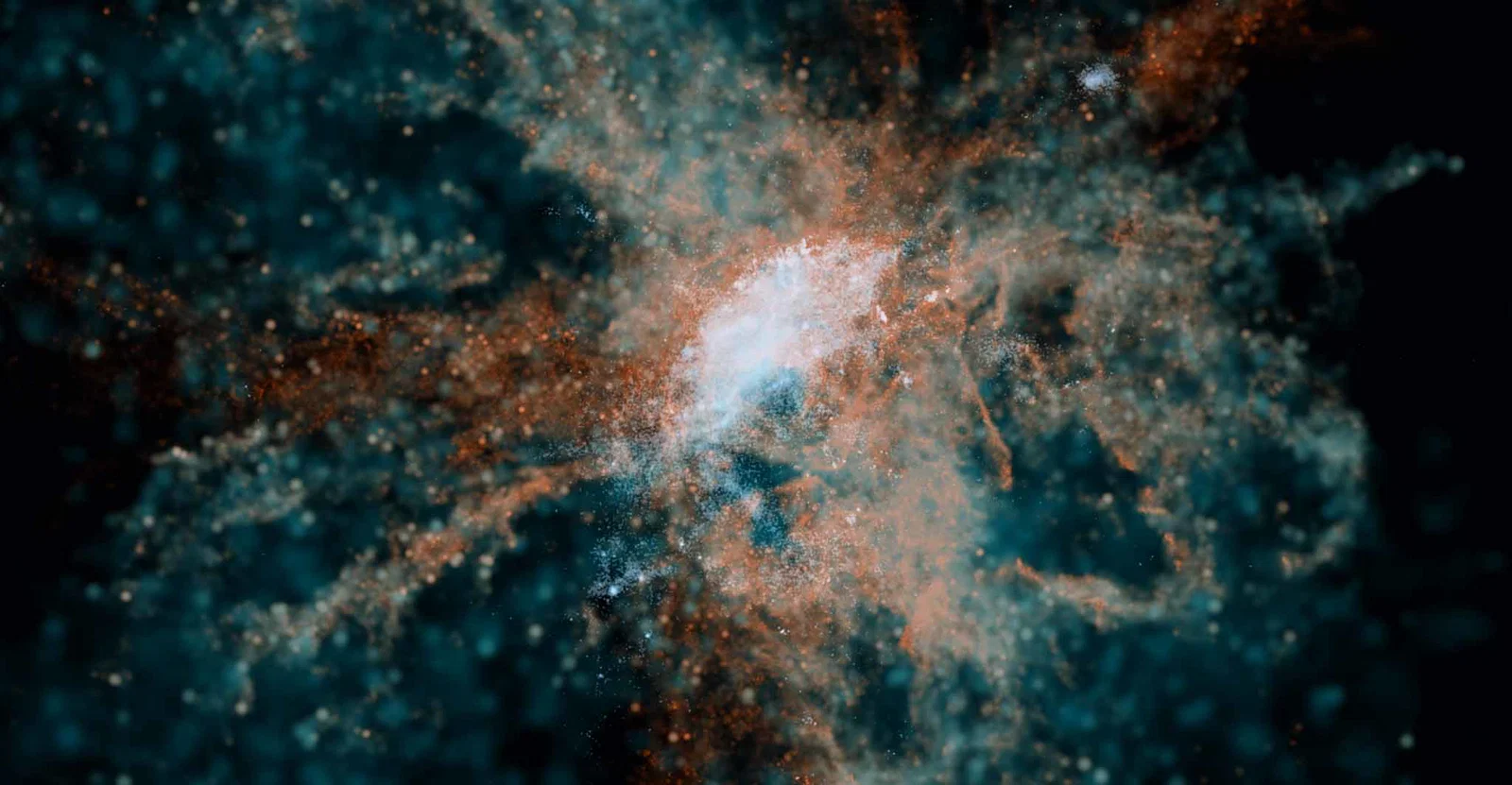
The James Webb Space Telescope (JWST) has provided unexpected insights into the early universe, shedding light on the difficulties scientists face in locating the first stars. A recent study by astronomers from the University of Arizona, published in Nature Astronomy, reveals that heavy elements appeared much earlier than previously believed—just 500 million years after the Big Bang, when the universe was only about 3% of its current age.
Read More
Due to the constraints of light speed, JWST's observations of distant galaxies effectively allow researchers to look back in time, uncovering a more complex early universe than the simpler helium and hydrogen clouds expected by astronomers. The telescope's data indicates that the early universe contained significantly more oxygen and carbon than had been assumed, raising questions about the formation and dispersion of these heavy elements.
First author Yongda Zhu, a postdoctoral researcher in the U of A Department of Astronomy and Steward Observatory, noted, "We observed that heavy elements escaped from galaxies very, very early in cosmic time. Not only were the galaxies producing these elements, but they were also dispersing them, possibly seeding other galaxies."
Traditionally, it was thought that hydrogen and helium were the first and only elements formed shortly after the Big Bang. These light elements had to come together to create stars, which in turn produced heavier elements through nuclear fusion—a process not fully understood for the early universe.
The team's research examined the Epoch of Reionization, a phase in which ultraviolet light gradually made the universe more transparent. Their observations focused on the light from galaxies that had traveled approximately 13 billion years to reach JWST. Zhu explained, “We used the galaxies themselves as background light sources. As light from the galaxies traveled toward Earth, it passed through surrounding gas, allowing us to analyze absorption patterns to identify specific elements.”
Detecting these faint spectra required 30 hours of exposure from JWST. Zhu manually searched through public repositories of JWST data, identifying three galaxies with blueshifted absorption patterns indicative of heavy elements.
The research found that the spectral fingerprints of these ancient galaxies closely matched those from later cosmic epochs, suggesting that heavy elements were produced and dispersed much earlier than previously thought. The study posits that a process known as baryon cycling, where matter cycles into and out of galaxies, facilitated the spread of these elements.
Zhu likened this process to food dye dispersing in water: “The color begins to spread through the water, and similarly, these heavy elements from early galaxies began to escape into space and ‘enrich’ their surroundings.”
This rapid spread of heavy elements might explain the challenges astronomers have faced in locating the pristine gas associated with the universe's first generations of stars. If heavy elements were produced and distributed early in cosmic history, they could have influenced a wide range of surrounding gas even before it could be directly observed.
The research paper, titled “Early Metal-Enriched Baryon Cycling Before the Midpoint of Cosmic Reionization,” was published on September 24, 2026.