New research indicates that conditions on early Earth may have stabilized enough to support the chemistry necessary for the emergence of life around 4.33 billion years ago. This study, co-led by Oleg Abramov, a senior scientist at the Planetary Science Institute, is published in Nature Communications.
Read More
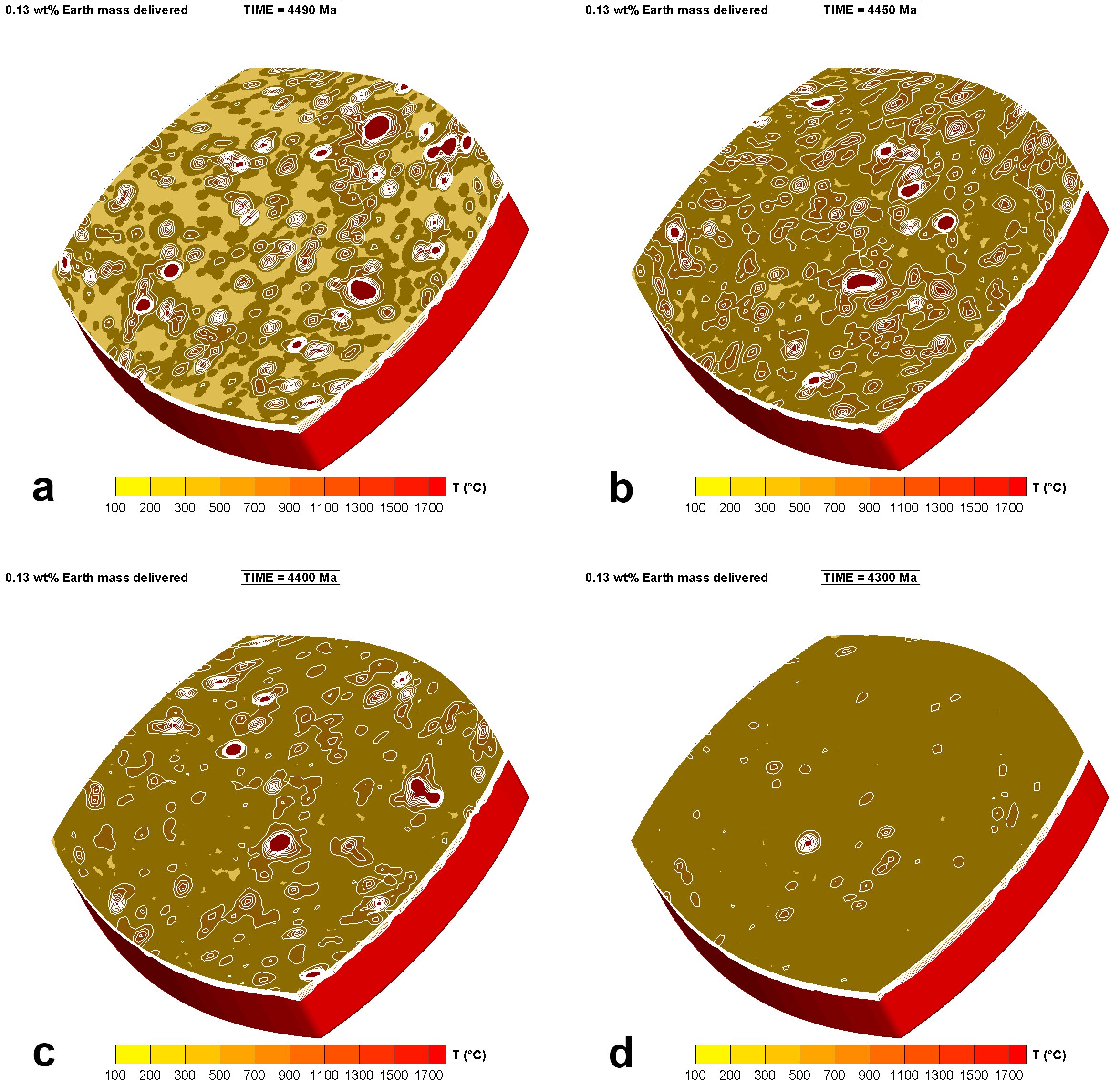
The researchers utilized a three-dimensional computer model to simulate the heating effects of asteroid, comet, and planetesimal impacts on Earth’s crust from 4.5 billion to 3.5 billion years ago. Their findings suggest that frequent global sterilization events due to these impacts persisted until approximately 4.4 billion years ago. Following this period, more stable environments began to form, allowing for the survival of RNA and other critical molecular structures associated with the origin of life.
Abramov noted their approach differed from previous studies by focusing on impact bombardment models, constrained by observable data like the lunar cratering record and certain chemical elements in Earth’s mantle. They evaluated both the harmful effects of impacts on biomolecules and the beneficial aspects, such as the creation of hydrothermal systems conducive to life. Their analysis indicates that optimal conditions for life may have developed between 4.4 billion and 4.3 billion years ago, peaking at around 4.33 billion years ago.
The research team highlighted the significance of the "RNA World" hypothesis, which suggests that RNA, capable of carrying genetic information and performing essential functions for replication, was a precursor to DNA-based life. For this RNA World to thrive, environmental stability was crucial.
Early Earth was dominated by impacts, resulting in an unstable environment. The study simulated impacts over one billion years, examining how they affected temperatures and the stability of vital life-forming molecules. It revealed a key transition point around 4.4 billion years ago, after which certain areas of Earth's shallow crust remained stable and never again exceeded critical temperature thresholds, creating what they called "never-sterilized" zones.
These areas began to appear as impact rates declined, and by 4.25 billion years ago, they constituted over half of the modeled crustal volume. Abramov emphasized that the emergence of these stable regions was essential, as prebiotic chemistry requires continuously stable temperatures.
Interestingly, the impacts not only posed challenges but also contributed to the development of hydrothermal systems. These systems, formed when water interacts with heated, fractured rock, are thought to have provided suitable conditions for the complex chemical reactions leading to life. By around 4.4 billion years ago, while the frequency of globally sterilizing impacts diminished, hydrothermal environments became prominent, especially around 4.3 billion years ago, coinciding with the time identified as highly favorable for life's chemical precursors.
The publication's details are as follows: Oleg Abramov et al, A Hadean timeline for the emergence of the RNA World, Nature Communications (2026).