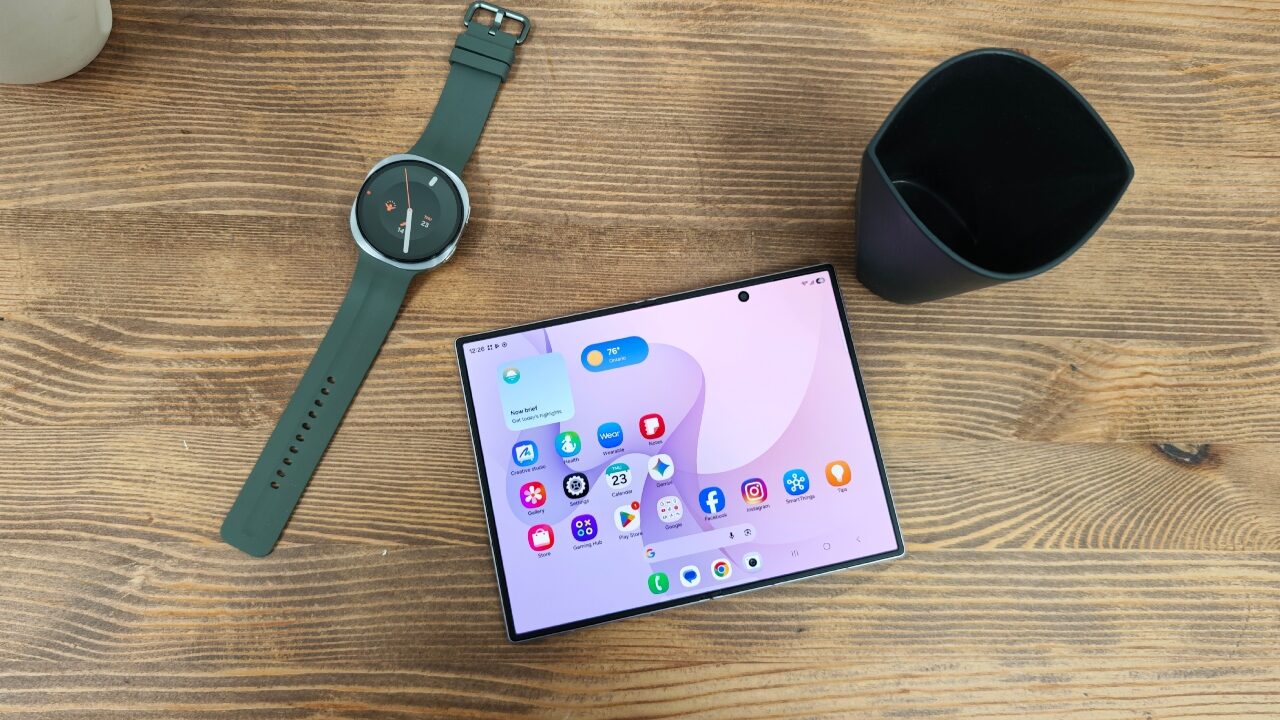
The Samsung Galaxy Z Fold8 marks a significant shift in the company's approach to foldable smartphones, showcasing meaningful innovation after years of minimal changes. Announced during this summer's Galaxy Unpacked event, the Galaxy Z Fold8 and its counterpart, the Z Fold8 Ultra, present new design elements that enhance user experience. While the Ultra model offers improved camera features and battery life, the Fold8 stands out with its impressive form factor.
Read More
The Z Fold8 measures 123.9 x 81.9 x 9.7 mm when folded, featuring a 5.5-inch Dynamic AMOLED 2X display, and 123.9 x 161.4 x 4.5 mm when unfolded with a 7.6-inch Dynamic AMOLED 2X display, weighing 201g. In contrast, the Z Fold8 Ultra weighs 215g and presents larger dimensions with a 6.5-inch display when folded and an 8-inch display when unfolded.
Initial impressions of the Z Fold8's design were mixed, but the finished product has proven to be both comfortable and user-friendly. The new form factor, resembling a thicker smartphone, allows for better weight distribution, making it more manageable than anticipated.
The folded 10:16 aspect ratio offers a familiar feel akin to a BlackBerry, although the keyboard occupies too much space, hindering visibility when reading messages. Users may find the Samsung keyboard unnecessarily large, resulting in typing errors when switching to other devices. However, the immersive experience this design provides makes it a favorite for tasks such as streaming and gaming.
The unfolded 4:3 aspect ratio is optimized for horizontal use, perfect for streaming apps and games. Unlike other devices with longer screens where content often gets cropped, the Z Fold8's design accommodates apps seamlessly. However, using the device one-handed can be challenging due to its width.
The Galaxy Z Fold8 is equipped with a 4800 mAh battery, which supports 45W wired, 20W wireless, and 4.5W reverse wireless charging. While not leading in terms of battery specifications, Samsung has done well with battery optimization, typically allowing users to end the day with around 40% remaining under heavy usage. Battery performance showed a consumption rate of about 5% every 30 minutes while gaming and 5% hourly for streaming content.
Gaming has turned out to be an unexpected highlight, with the Z Fold8 maintaining a solid 60 FPS in Fortnite at high settings, outperforming the standard S26 model in performance. However, it does tend to heat up with extended use. Players noted the ergonomic advantages of the wider display, enhancing gameplay comfort.
Camera specifications may leave some users wanting more, as both the folded and unfolded selfie cameras are 10 MP, down from 12 MP in previous models. The rear cameras include a 50 MP wide lens and a 50 MP ultrawide lens, lacking a telephoto option. While decent for everyday photography, the Z Fold8 struggles with focus at longer distances, particularly in low-light conditions compared to higher-end models.
Starting at $1899 USD (or $2400 CAD) for the 256GB model, the Z Fold8's price raises questions about value, especially when the Z Fold8 Ultra offers enhanced features for a slightly higher cost. Nonetheless, for users who appreciate the unique foldable design, the Z Fold8 is a compelling option. It represents a notable evolution in foldable technology, although it sacrifices some camera capabilities and battery performance in the process.