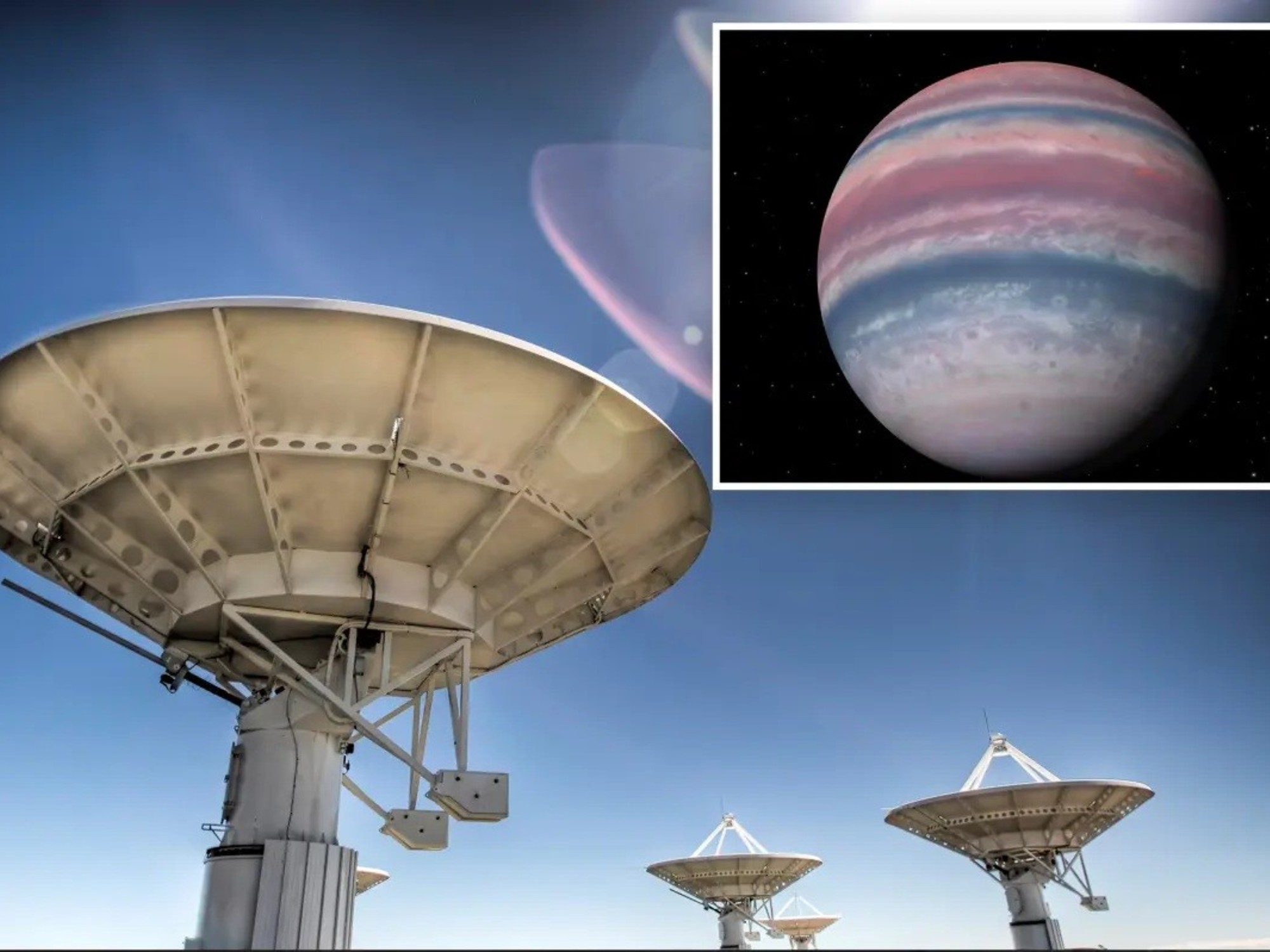
Astronomers have made a significant breakthrough by directly detecting radio emissions from the exoplanet Beta Pictoris b, located approximately 63 light-years from Earth. This marks the first time such a phenomenon has been observed, providing clear evidence of a powerful planetary magnetic field. The signals are generated naturally by massive auroral storms, intensified by the planet's rapid rotation, rather than being linked to extraterrestrial intelligence, as noted by Edo Berger, a professor of astronomy at Harvard University.
Read More
The study, led by Kevin Ortiz Ceballos at the Center for Astrophysics | Harvard & Smithsonian, is available on the preprint server ArXiv and is based on high-resolution observations from the MeerKAT radio telescope array in South Africa. Key details of the discovery include:
- Target Exoplanet: Beta Pictoris b, a gas giant with about 12 times the mass of Jupiter.
- Distance: 63 light-years away in the constellation Pictor, orbiting a star that is 1.75 times more massive than the Sun.
- System Age: Around 23 million years old, making it a relatively young planetary system compared to our 4.5-billion-year-old solar system.
- Signal Properties: Radio bursts detected between 0.85 GHz and 3.5 GHz, displaying strong circular polarization.
- Magnetic Field Strength: An extraordinary intensity measured at least 1.25 kilogauss, more than 200 times stronger than Jupiter's magnetic field.
The radio emissions are generated through processes similar to those responsible for Earth’s auroras and the radio waves observed near Jupiter and Saturn. High-energy charged particles trapped in Beta Pictoris b's magnetic field accelerate along the poles, causing intense bursts of coherent radio waves alongside visible and ultraviolet light emissions.
Unlike previous observations of tentative radio signals from other systems—such as the red dwarf YZ Ceti—this detection confirmed the radio pulses originated from Beta Pictoris b rather than its host star. Independent researchers noted that the high frequency of the radio waves challenges traditional models, which expected exoplanetary emissions at lower frequencies similar to those of our gas giants.
The Beta Pictoris system is extensively studied in modern astrophysics, containing three confirmed giant planets, numerous comets, and a large circumstellar disk of cosmic dust first observed in 1984. The research team is seeking additional observation time on global radio telescope arrays to investigate the rotational period of Beta Pictoris b and assess potential magnetic activity from other planets in the system.