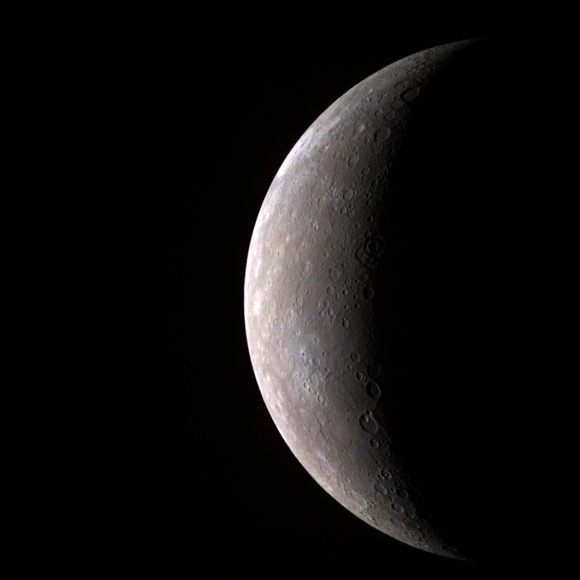
New research led by the German Aerospace Center’s Institute of Space Research reveals that Mercury, the smallest planet in the Solar System, has contracted by nearly 19 kilometers (12 miles) in diameter. The study highlights that crater debris on the planet's surface obscured signs of this shrinkage.
Read More
Mercury formed approximately 4.5 billion years ago through violent collisions among rocks and asteroids. As these impacts generated heat, the planet began cooling, leading to a decrease in its interior size, similar to a deflating balloon. This cooling process caused the outer rocky layers to compensate by crumpling and cracking, resulting in tectonic features such as scarps and ridges.
Dr. Gaku Nishiyama, the lead author of the study, emphasized the importance of understanding how much Mercury's radius has decreased due to planetary cooling. By analyzing the shortening structures—tectonic features that indicate the planet's global contraction—researchers estimated this shrinkage.
Interestingly, the landforms observed do not correspond to the expected uniform pattern from global cooling, suggesting that some features might have been obscured by resurfacing events, such as deposits from impacts. To investigate this, the researchers used surface roughness as an indicator of geological freshness.
The team combined previous geological maps with new data on the surface roughness across Mercury. They discovered that regions with the roughest terrain displayed fewer visible wrinkles. By examining the necessary contraction to form shrinkage ridges and scarps in less disrupted areas, they estimated the total contraction across the planet, which could be as much as 23 kilometers (14.5 miles) in diameter rather than the previously estimated 4-16 kilometers (2.5-10 miles).
Dr. Nishiyama expressed that a possible 30% increase in contraction was unexpected but made sense given the updated estimates. These findings indicate that current observations about Mercury’s cooling and shrinking align more closely with theoretical predictions, thereby enhancing our understanding of the solar system's smallest rocky planet.
The research was published in the journal Geophysical Research Letters.