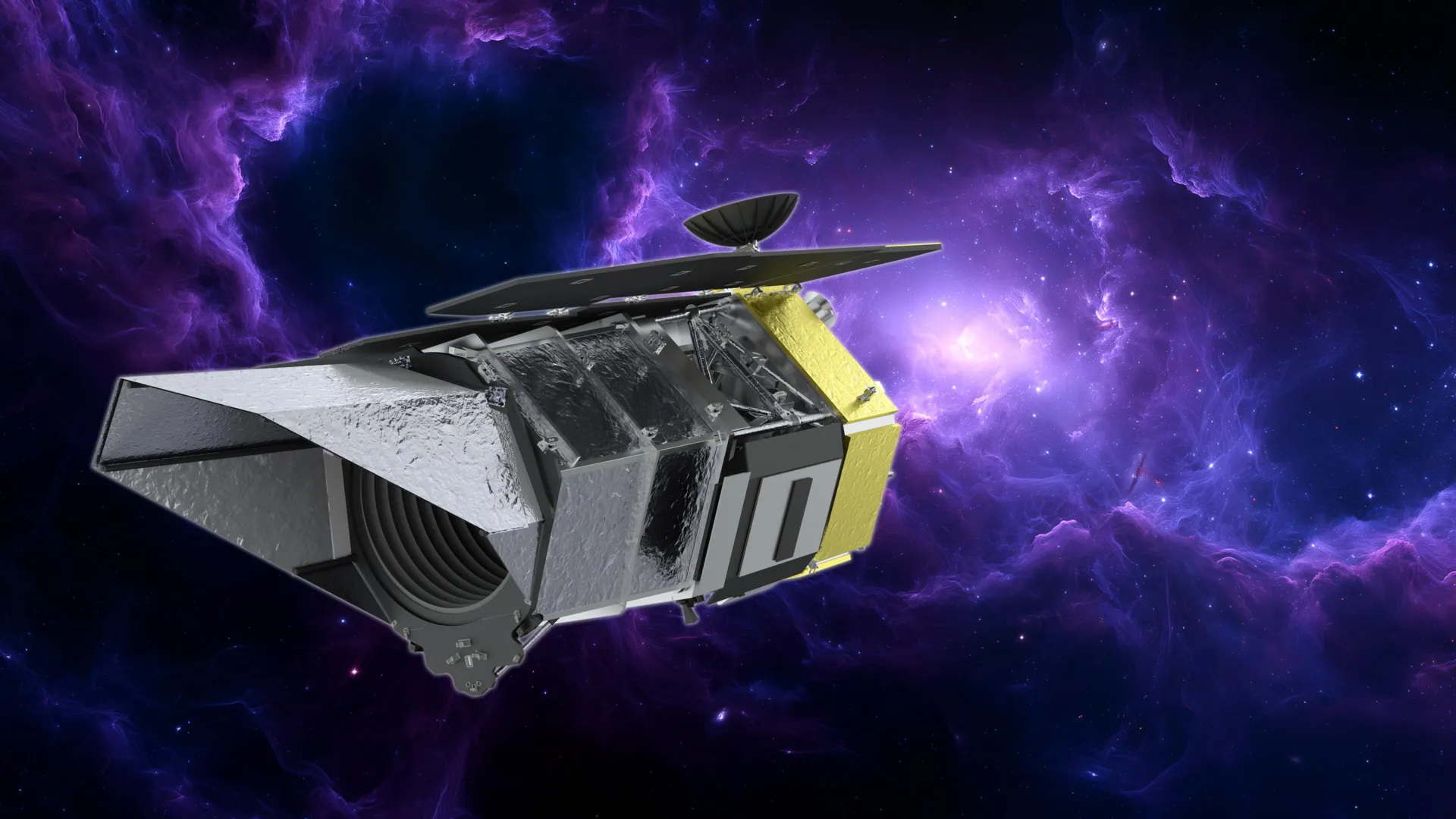
NASA has successfully powered up the Wide Field Instrument (WFI) of the Nancy Grace Roman Space Telescope, marking a significant milestone in the mission. This 300-megapixel infrared camera is designed to survey vast regions of the universe quickly while capturing detailed images.
Read More
The Coronagraph Instrument, which will be used for planet imaging, has also completed initial checks of its digital, electronic, and mechanical systems after being activated earlier this month. These evaluations are part of a lengthy commissioning process that will occur as Roman travels approximately one million miles to the second Lagrange point (L2).
The WFI combines a wide field of view with high-resolution imagery comparable to NASA's Hubble Space Telescope. Each image captured by the WFI can cover an area of the sky larger than the apparent size of a full moon. This capability will enable Roman to perform extensive surveys, contributing to research on exoplanets, dark energy, and the arrangement of matter in the universe. The data generated is expected to support numerous scientific studies.
"After years of effort to build and test the instrument on the ground, we now have confirmation that it is operational in space. This is a huge milestone for the team at Goddard and our industrial partners," remarked Josh Schlieder, the Wide Field Instrument scientist at NASA's Goddard Space Flight Center.
Before powering on the WFI, engineers conducted a decontamination process over ten days, during which the instrument was kept warm at minus 85 degrees Fahrenheit (minus 65 degrees Celsius). On September 11, they cooled the WFI down to minus 225 degrees Fahrenheit (minus 143 degrees Celsius) to activate its 18 infrared detectors, which collectively have a light-sensitive area the size of a laptop screen.
The team also successfully tested the instrument's calibration system and began transmitting test data back to Earth. They then shifted focus to testing the element wheel, which contains filters and prisms, and later assessed the WFI's focusing mechanism, essential for capturing sharp images across the telescope's expected vast output.
The Wide Field Instrument is operating as expected, with plans for its first science images set to be released by early 2027.
In addition, Roman's Coronagraph Instrument, designed to directly image planets orbiting other stars, has passed early operational checks. Its advanced technology aims to suppress starlight to enable the detection of fainter planetary reflections.
The Coronagraph Commanding Center at Caltech/IPAC confirmed successful communication with all major components of the coronagraph, including its software and control systems. Engineers verified that its thermal system is functional, maintaining an optimal temperature of about 72 degrees Fahrenheit (22 degrees Celsius) for operational stability.
Eric Cady, an optical engineer at NASA's Jet Propulsion Laboratory, noted that the coronagraph is currently undergoing decontamination to ensure optimal conditions for its detectors, a process expected to continue for 30 days alongside initial calibration efforts.