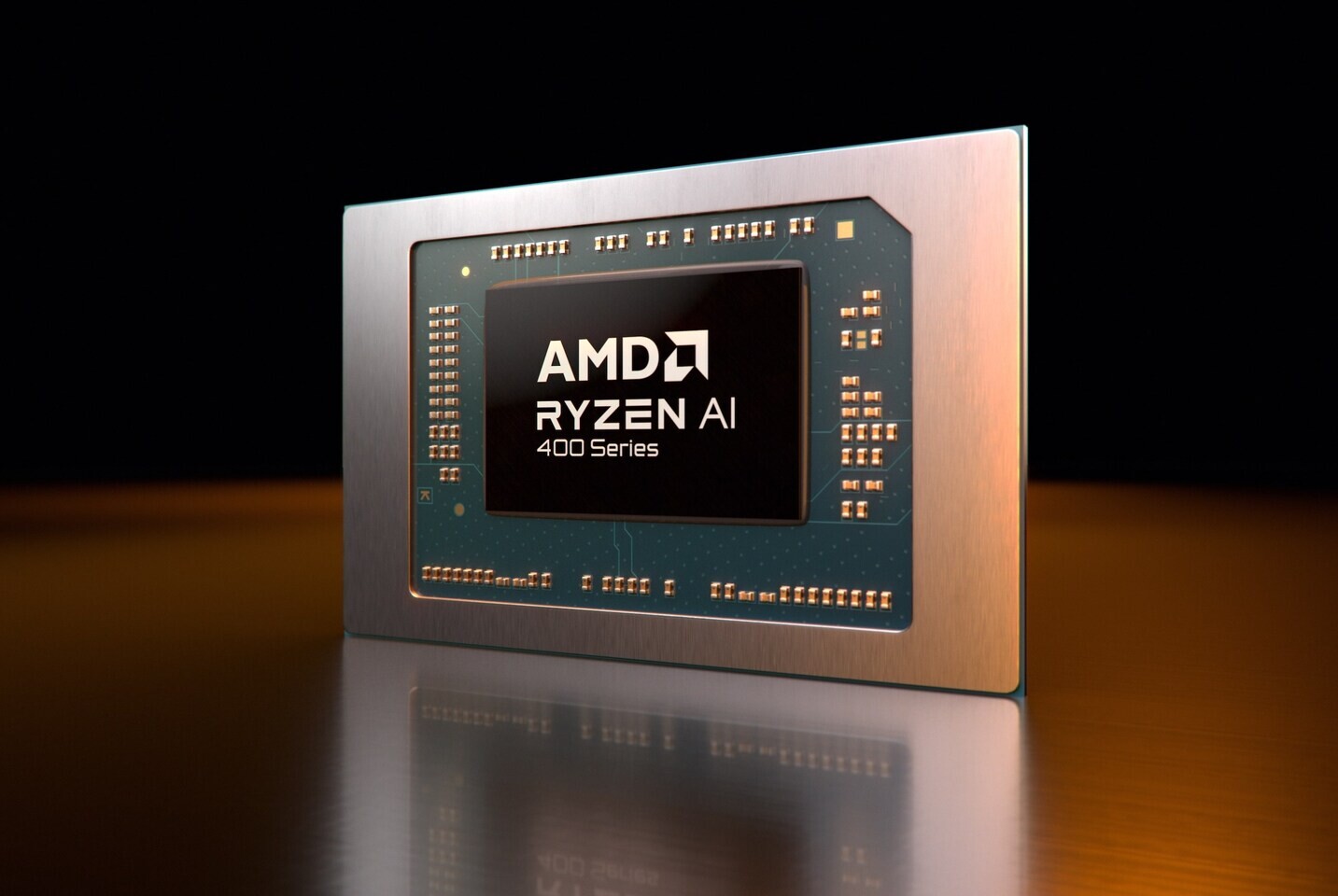
At the 2026 International CES, AMD introduced the Ryzen AI 400 series mobile processors, dubbed "Gorgon Point," which will form the cornerstone of the company's client processor lineup through 2026. These processors are built on a new 4 nm silicon technology, improving upon the existing "Strix Point" design with enhanced clock speeds and power management features.
Read More
The Ryzen AI 400 series utilizes the "Zen 5" microarchitecture, featuring a dual-CCX configuration. This includes four full-sized "Zen 5" cores sharing a 16 MB L3 cache and eight compact "Zen 5c" cores with an 8 MB L3 cache. The "Zen 5" cores can boost up to 5.20 GHz, while the integrated GPU (iGPU) can reach up to 3.10 GHz, based on the RDNA 3.5 architecture with 16 compute units (CU). Both the CPU and iGPU demonstrate improved performance over the previous "Strix Point" generation.
In addition to CPU and iGPU enhancements, the integrated Neural Processing Unit (NPU) sees an increase in performance, now achieving a peak throughput of 60 TOPS, up from 55 TOPS with the Ryzen AI 300 series. The processors also come with a comprehensive ROCm software stack, enabling client AI applications to utilize the capabilities of the NPU, CPU, and iGPU.
The integrated memory controllers offer native support for LPDDR5X memory speeds of up to 8533 MT/s, an improvement from the 8000 MT/s supported by "Strix Point." Although "Gorgon Point" shares a similar physical design with its predecessor, AMD has restructured the lineup, giving each of the seven new consumer processor models enhancements over their Ryzen AI 300 series counterparts, which may include changes in core speeds, core counts, iGPU compute units, and NPU throughput.
Leading the series is the Ryzen AI 9 HX 475, featuring a 12-core/24-thread CPU, maximum boost frequency of 5.20 GHz, a 16 CU iGPU with a boost up to 3.10 GHz, and a 60 TOPS NPU. Following closely is the Ryzen AI 9 HX 470, which matches the CPU and iGPU specifications but has a NPU capped at 55 TOPS.
The next models include the Ryzen AI 9 465, equipped with a 10-core/20-thread CPU (4 "Zen 5" and 6 "Zen 5c"), a maximum boost frequency of 5.00 GHz, a 12 CU iGPU, and a 50 TOPS NPU. The Ryzen AI 7 460 features an 8-core/16-thread CPU (4 "Zen 5" and 4 "Zen 5c"), an up to 5.10 GHz boost frequency, an 8 CU iGPU, and a 50 TOPS NPU. The Ryzen AI 7 445 and Ryzen AI 7 435 have similar configurations, differing mainly in clock speed, while the entry-level Ryzen AI 5 430 includes a 4-core/8-thread CPU, 4 iGPU compute units, and a 50 TOPS NPU.
Notebooks powered by the Ryzen AI 400 series are expected to be available from late January 2026 across multiple OEMs.