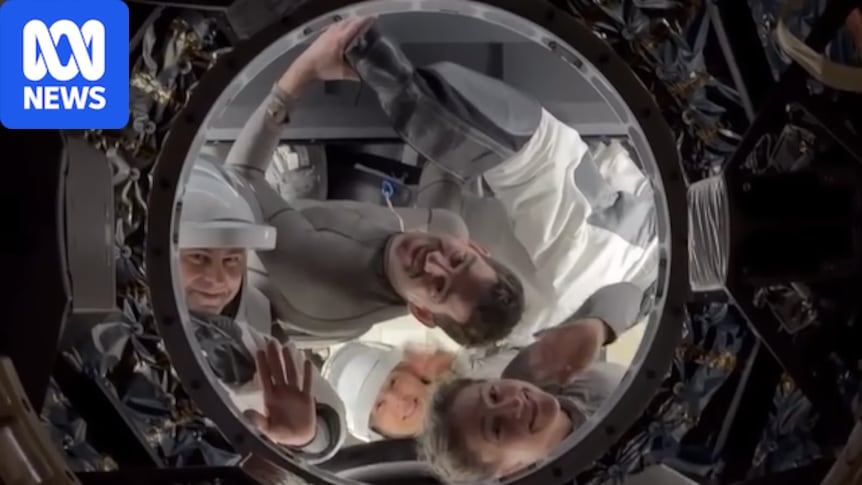
NASA's SpaceX Crew-12 is set to return to Earth after a 237-day mission aboard the International Space Station (ISS). The crew, which launched on February 13, conducted vital research to aid future human exploration of the Moon and Mars.
Read More
As of Wednesday evening, Australian time, the astronauts have begun their voyage home, following the closure of the Dragon capsule's hatch at 6:05 AM EDT (8:05 PM AEST) and undocking from the ISS at 8:05 AM EDT (10:05 PM AEST).
The crew's expected splashdown in the Pacific Ocean off California is scheduled for Thursday. Key timings are as follows:
- 10:20 AM EDT Thursday (12:20 AM AEST Friday): NASA will begin live coverage of the return voyage.
- 10:46 AM EDT Thursday (12:46 AM AEST Friday): The SpaceX Dragon capsule will initiate its deorbit burn.
- 11:34 AM EDT Thursday (1:34 AM AEST Friday): Splashdown is expected, followed by retrieval operations by NASA and SpaceX.
During their transit, the astronauts will consume fluids from bags with salt tablets to maintain hydration and adjust to Earth's gravity.
The Crew-12 comprises NASA's Jessica Meir (Commander), Jack Hathaway (Pilot), French engineer Sophie Adenot, and Russian cosmonaut Andrey Fedyaev. This mission marked Meir's second spaceflight, while Hathaway, who became an astronaut in 2021, made his inaugural journey.
Adenot also joined as a first-time space traveler, and Fedyaev previously spent 186 days on a different mission in 2023. The Crew-12 astronauts conducted biological research, food production studies, and assessments of various medical and environmental factors related to space travel.
They will be replaced by NASA’s Crew-13, which launched on October 1. This crew is led by Commander Jessica Watkins, marking a historic moment as she is the first Black woman to command a mission in orbit. Crew-13 includes Luke Delaney, Joshua Kutryk from Canada, and Sergey Teteryatnikov from Russia. Their mission will last six months, during which they will undertake ongoing research.
The ISS, initiated in 1988 and continuously inhabited since 2000, serves as a platform for international cooperation in space, with ongoing research aimed at supporting future long-duration missions beyond low Earth orbit.