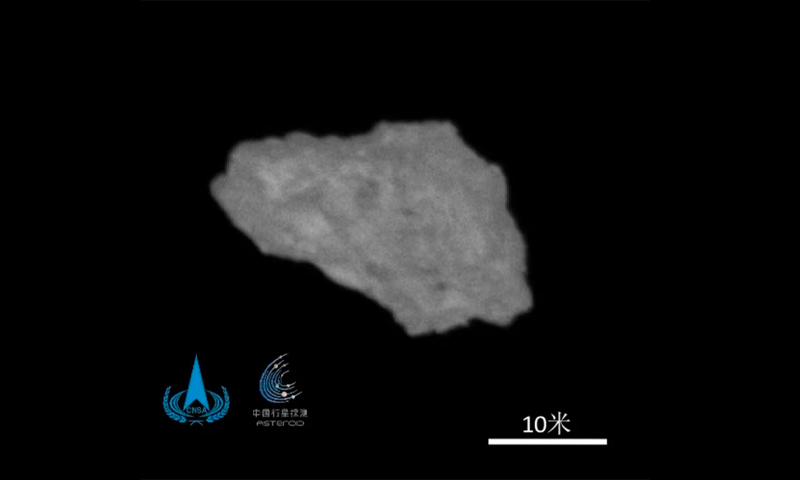
China's Tianwen-2 probe has successfully reached the near-Earth asteroid Kamo'oalewa, also known as 2016 HO3, after a journey of approximately 1 billion kilometers. The probe is now about 20 kilometers away from the asteroid and has officially begun its scientific exploration.
Read More
The China National Space Administration (CNSA) announced this milestone on Monday, noting that the 400-day journey included capturing imaging data of the asteroid. Utilizing optical navigation data collected during its approach, the mission team improved the asteroid's ephemeris, narrowing its positional uncertainty from over 100 kilometers to just a kilometer.
Tianwen-2 was launched from the Xichang Satellite Launch Center in Sichuan Province on May 29, 2025. During its flight to the asteroid, it executed several critical maneuvers, including deep-space trajectory adjustments and mid-course corrections. The probe first detected asteroid 2016 HO3 on June 6, and a day later, it performed a maneuver to align its flight path with the asteroid at approximately 30,000 kilometers away. By June 19, it had moved to within 2,000 kilometers of the asteroid.
In the next phase, Tianwen-2 will conduct detailed observations to analyze the asteroid's surface, material composition, and internal structure, aimed at gathering data crucial for the mission's planned sample collection. The updated ephemeris for Kamo'oalewa has been released through China's Lunar and Planetary Data Release System.