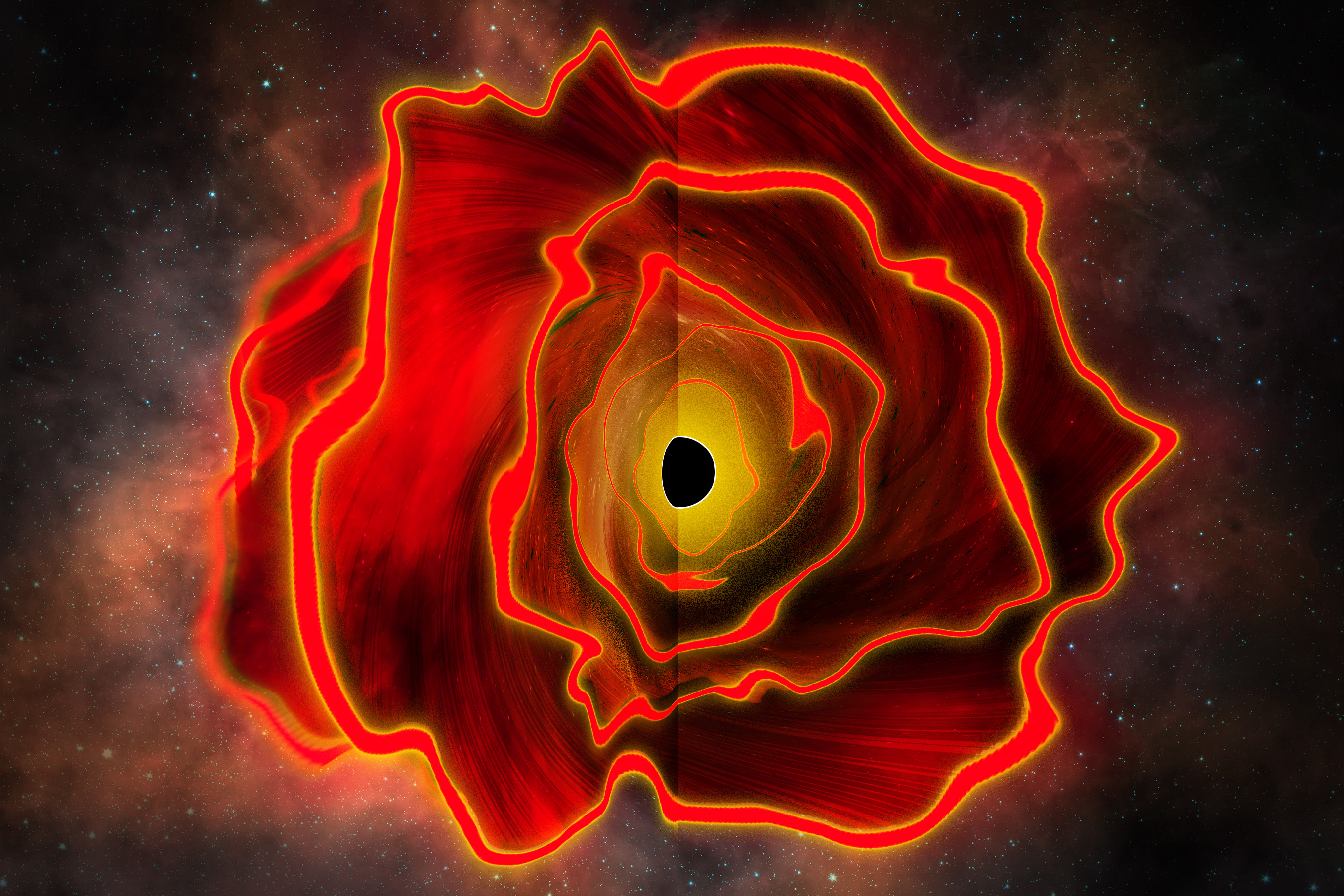
Researchers led by Rohan Naidu, a NASA Hubble Fellow and Pappalardo Fellow at MIT, have identified a new type of astrophysical object, provisionally named MoM-BH*-1. This object is believed to contain a central black hole approximately 100,000 times more massive than the sun, surrounded by an extensive envelope of gas resembling a star the size of the solar system. This discovery could elucidate the nature of several mysterious “little red dots” identified in deep-space images captured by the James Webb Space Telescope (JWST).
Read More
Naidu explained that these red dots appear abundant in the early universe but have vanished by the present day. The study's co-authors include Robert Simcoe and Wendy Sun from MIT, along with collaborators from various institutions. While the researchers initially aimed to identify some of the universe's earliest galaxies for their project called “Mirage or Miracle” (MoM), they unexpectedly discovered this intriguing red dot.
The team employed JWST to probe deep into space, exploring regions of the universe that formed mere hundreds of millions of years after the Big Bang. They were drawn to a distinct bright red dot that did not align with common astrophysical phenomena. Typically, a red hue suggests that an object is obscured by dust, similar to how smoke alters the color of the sky. Simcoe noted that while this could be the case, the object also exhibited unusual light patterns. Most notably, there was a significant drop-off in light at specific wavelengths, known as a “Balmer break,” which is indicative of dense gas absorbing photons.
This spectral feature was described by Naidu as the most pronounced they had encountered, challenging the possibility of the object being an ordinary star. Further analysis revealed that the light from the dot showed almost no signatures of metals, indicating a unique composition.
To clarify the nature of the object, the team simulated various astrophysical scenarios. They discovered that a dense screen of hydrogen could account for the object's compelling brightness, provided it is structured like an enormous star rather than a light cloud. However, the object’s extreme luminosity—estimated to be 100 billion times brighter than typical stars—suggested nuclear fusion couldn't explain the energy output. Instead, they posited an active, accreting black hole could be responsible for the brightness.
By adjusting the mass of this black hole in their simulations, the researchers deduced that MoM-BH*-1 most likely represents a black hole star, characterized by the massive black hole at its center and a dense hydrogen cocoon. The discovery implies that this object may be the first of its kind, with potential implications for many similar red dots observed in JWST images. Naidu indicated that while MoM-BH*-1 is overtly radiating light as a black hole star, other red dots may also signify similar objects within their own galaxies.
This research was supported by the MIT Department of Physics, NASA, and the Space Telescope Science Institute.