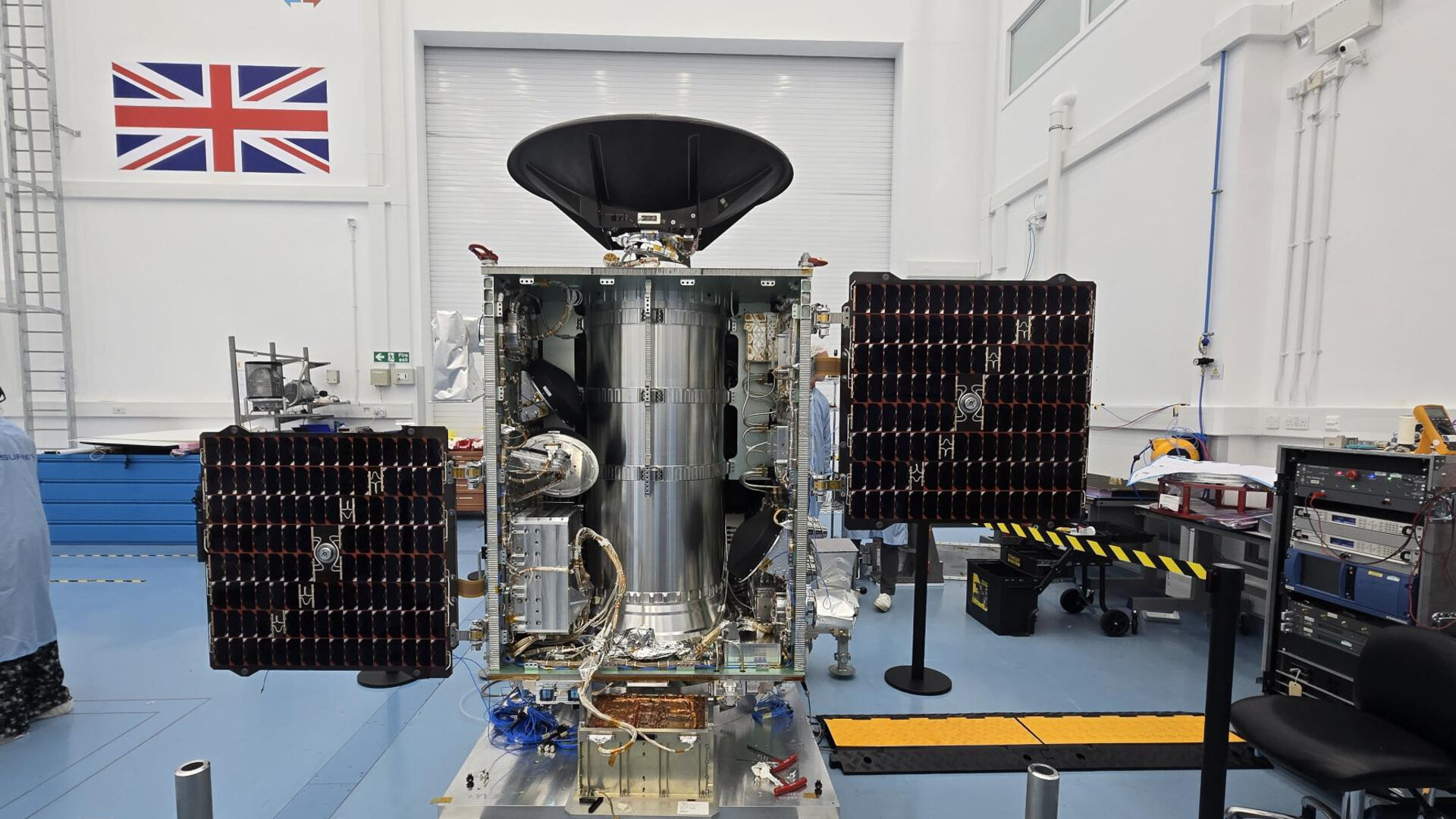
Lunar Pathfinder, the European Space Agency's (ESA) first lunar communications relay satellite, is set to aid future missions to the Moon by providing reliable communication channels. Developed in collaboration with Surrey Satellite Technology Ltd (SSTL) in the UK, this satellite will operate in lunar orbit and transmit data between Earth and spacecraft operating on and around the Moon, marking a significant step in the new era of lunar exploration.
Read More
As the first component of ESA’s Moonlight initiative, Lunar Pathfinder is designed to establish a dedicated communications infrastructure for Europe on the Moon, paving the way for a future constellation of lunar services. This satellite will primarily benefit small orbiters and assets in areas with limited visibility to Earth, such as the lunar far side and polar regions. Through the provision of a shared communication service, Lunar Pathfinder will enable future missions to use an existing relay network, rather than relying on heavy and power-intensive onboard communication systems, thus minimizing individual mission complexity and allowing resources to be redirected toward scientific endeavors.
Lunar Pathfinder is scheduled to travel to the Moon as part of Firefly Aerospace’s Blue Ghost Mission 2. Once launched, Firefly’s Elytra transfer vehicle will place the satellite into an elliptical lunar frozen orbit, maintaining visibility from the lunar south pole to the equator, and ensuring stability over time. Following its arrival in lunar orbit, the satellite will initiate communications relay services, with one of its first users being LuSEE-Night, a NASA radio astronomy experiment set to be delivered to the lunar far side during the same mission.
In addition to its communication capabilities, Lunar Pathfinder will carry RADMON, a radiation monitor developed by Thales Alenia Space in Switzerland, to assess radiation conditions around the Moon. It will also demonstrate the simultaneous use of radio, Global Navigation Satellite System (GNSS), and laser-ranging techniques for the first time on a lunar-orbiting spacecraft. This includes
a GNSS receiver from SpacePNT in Switzerland, aimed at evaluating terrestrial navigation satellite system usability from the Moon;
a NASA laser retroreflector for supporting laser ranging with Earth;
and an X-band transponder created by Thales Alenia Space in Spain for two-way radio ranging metrics with ground stations like ESA’s ESOC site.
These technological demonstrations will contribute to advancements in precise positioning and navigation around the Moon.
The Lunar Pathfinder project commenced in 2018 when ESA, SSTL, and Goonhilly Earth Station agreed to collaborate on lunar communications services. NASA selected Firefly Aerospace in 2023 for the transportation of Lunar Pathfinder to lunar orbit through a barter agreement, whereby ESA provides lunar communication services in exchange for transport to the Moon. Currently, Lunar Pathfinder is undergoing final environmental tests in the UK before its anticipated launch in 2027 aboard a SpaceX Falcon 9 rocket. Once operational, it is expected to deliver communication services for about eight years and support ten international missions, responding to the increasing demand for shared lunar infrastructure.