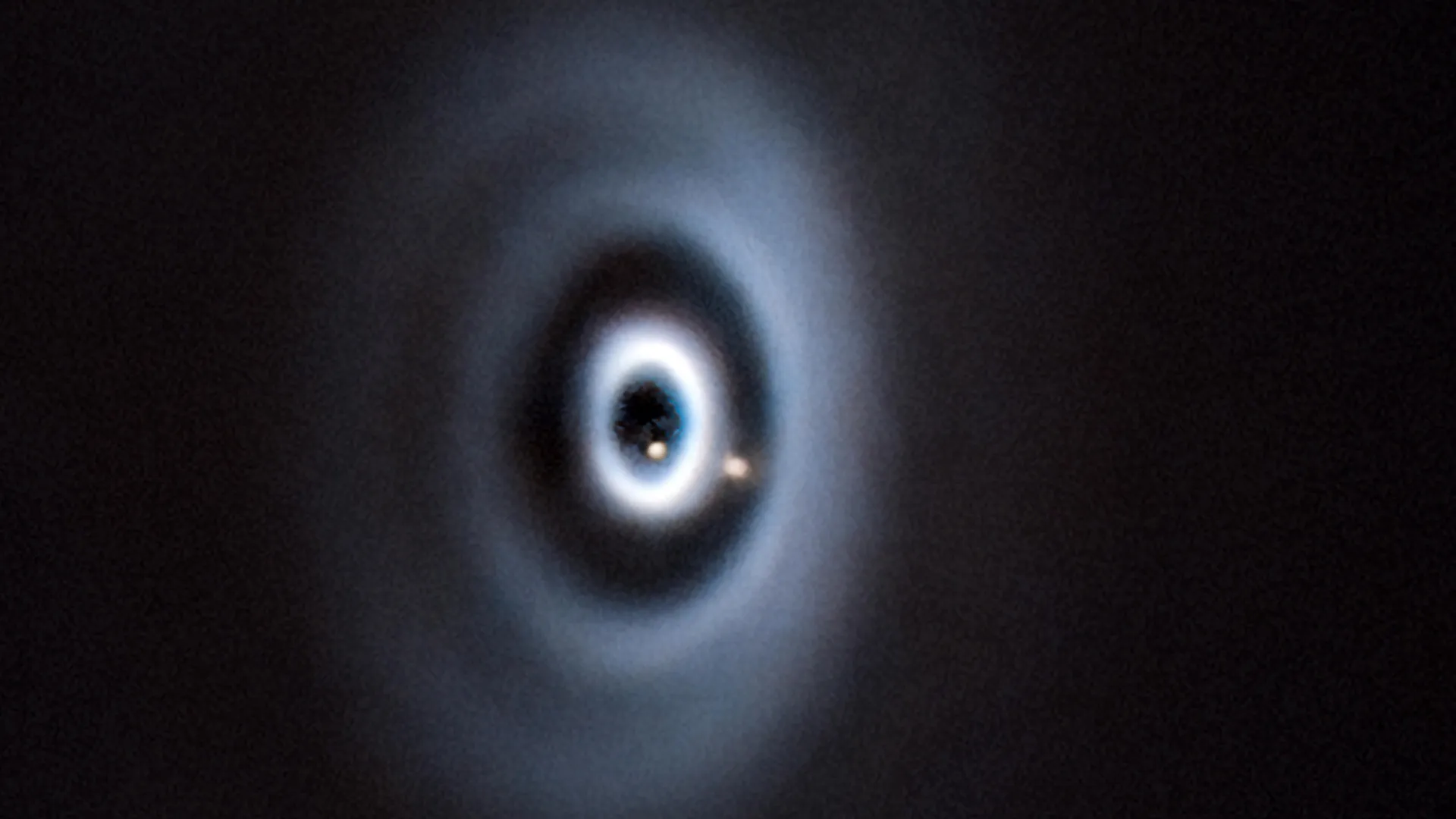
A recent study led by planetary scientists Paolo Sossi and Dan Bower from ETH Zurich challenges long-held views about the origins of Earth's building materials. Traditionally, many researchers believed that 6 to 40 percent of the raw material that formed Earth came from the outer Solar System, beyond Jupiter. This hypothesis was especially relevant for explaining how Earth acquired volatile substances like water, suggesting that material moved between the inner and outer regions during Earth's formation.
Read More
In their new research, published in *Nature Astronomy*, Sossi and Bower analyzed isotope ratios from various meteorites, including those linked to Mars and the asteroid Vesta. Isotopes are atoms of the same element that have different masses due to varying numbers of neutrons. Their analysis revealed that Earth’s materials came entirely from the inner Solar System, potentially indicating that less than two percent of Earth's mass originated from the outer Solar System.
Sossi noted, "Our calculations make it clear: the building material of the Earth originates from a single material reservoir." Bower added, "We were truly astonished to find that the Earth is composed entirely of material from the inner Solar System distinct from any combination of existing meteorites." The study employed data from ten different isotope systems, a broader analysis than previous studies that typically focused on only two.
For decades, scientists used isotope analysis in meteorites to trace origins, mainly relying on oxygen isotopes. However, a breakthrough in the early 2010s introduced isotopes of chromium and titanium for this purpose. This led to a classification of meteorites into two groups: non-carbonaceous meteorites from the inner Solar System and carbonaceous meteorites from the outer Solar System. The current analysis supports that Earth is composed solely of non-carbonaceous material, with no evidence of material exchange between inner and outer Solar System regions.
The researchers theorize that Jupiter's rapid growth played a crucial role in creating two distinct material reservoirs. Its strong gravitational pull likely formed a barrier within the protoplanetary disc surrounding the young Sun, restricting the movement of outer Solar System material into the inner region. The new findings imply that very little material from beyond Jupiter contributed to Earth's formation.
Additionally, the study suggests that Earth, Mars, and Vesta share a similar material composition, leading the researchers to hypothesize that Mercury and Venus may exhibit the same pattern. However, this hypothesis cannot currently be tested as there are no rock samples available from those planets.
A significant question raised by the research is about the source of Earth's water. If Earth did not acquire large quantities of water-rich material from the outer Solar System, scientists must explore how sufficient water existed in the inner Solar System to eventually form Earth's oceans. Sossi and his team plan to pursue investigations into this inquiry and the potential for similar processes to occur in other planetary systems.