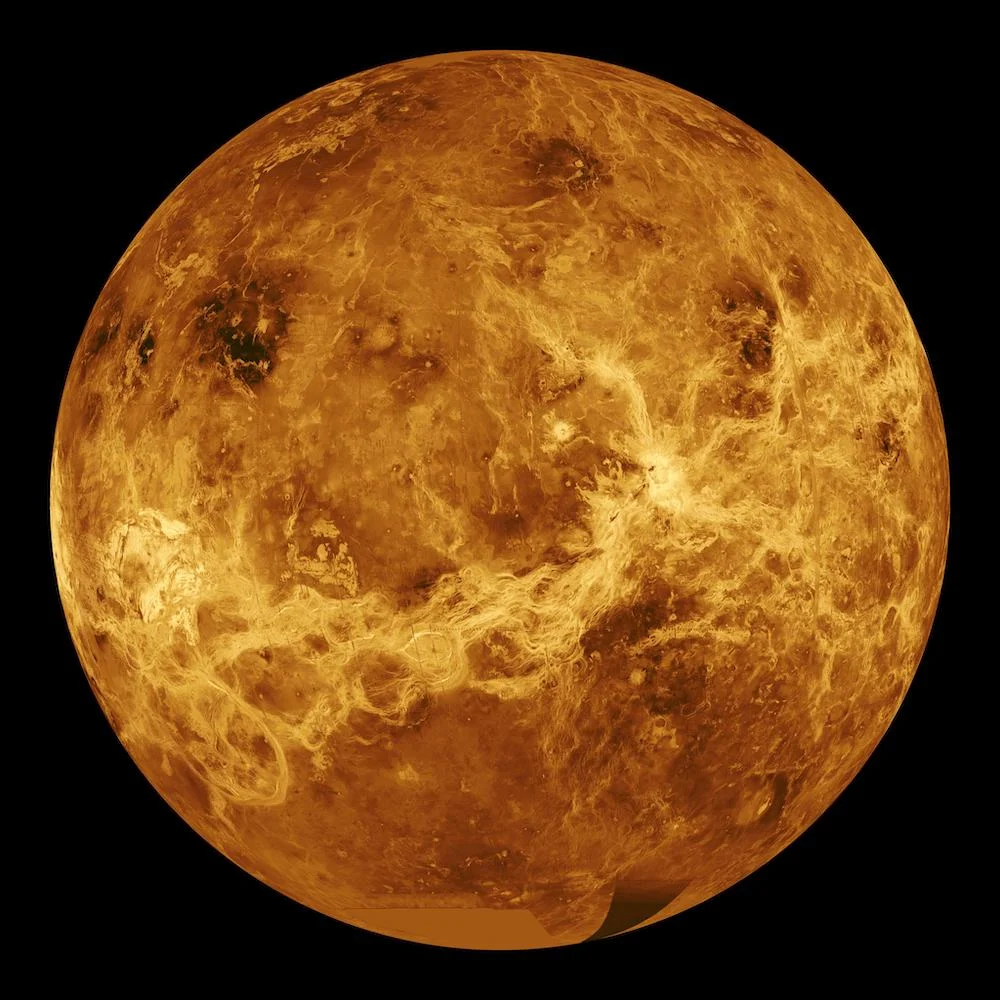
Planetary scientists have long compared Venus to Earth, labeling it as Earth's 'sister planet' due to their similar size and composition. However, significant differences exist between the two, particularly in their environments: while Earth supports life, Venus is characterized by extreme heat and a dense atmosphere. One notable distinction is that Earth has a moon, whereas Venus does not, raising questions about whether it ever had a moon and what might have happened to it.
Read More
A study published in The Astrophysical Journal, led by Stephen R. Kane, a professor of planetary astrophysics at the University of California, Riverside, explores these questions. The research, titled "Tidal Demise: The Evolution and Fate of a Hypothetical Venus Moon," delves into the potential existence of a moon around Venus and considers whether it was lost to a collision, not necessarily with Venus itself, but with another object.
The authors argue that if Venus had a moon, its characteristics—such as the planet’s slow rotation period of 243 days and its retrograde spin—coupled with the gravitational influence of the Sun, would likely result in the moon spiraling inward and ultimately colliding with Venus. Kane stated, “My study shows Venus didn’t require a catastrophe to arrive at what we can see today. It turns out the gravity of the planet itself combined with the rate at which it spins naturally caused the moon to collapse on top of it.”
The evolutionary paths of Earth and Venus diverged significantly over billions of years, with the lack of a moon on Venus remaining a critical area of study in comparative planetology. To investigate this, Kane and his colleagues created a computer model simulating gravitational interactions between a hypothetical moon and Venus. They examined varying masses of the hypothetical moon, from half to ten times that of Earth's Moon, and altered Venus's rotation rate to include scenarios of earlier rapid spins.
Results from their simulations consistently indicated that a hypothetical moon would eventually crash into Venus, with more massive moons facing impacts sooner. Kane expressed surprise at this outcome, as he initially expected a diversity of results given the various scenarios explored.
While the research does not definitively prove that Venus had a moon, it does suggest that if it existed, it would not have lasted long. The authors noted that to explain Venus's current state, the moon's loss and the planet's deceleration from a faster initial rotation must both be accounted for.
Finding evidence of such a moon would present difficulties due to the planet's inhospitable conditions, which have limited lander missions to just brief survivals. Moreover, Venus's surface is relatively uncratered, indicating that a significant resurfacing event occurred hundreds of millions of years ago, potentially erasing signs of any previous moon.
Nevertheless, scientists remain hopeful of uncovering evidence of an ancient moon’s collision with Venus, as similar geological clues have been found on Earth. The ongoing NASA DAVINCI mission aims to study Venus’s atmosphere and surface, which could provide insights into its geological history and any potential past moons.
Kane pointed out that while Venus may have once had a more hospitable climate, a moon could have played a crucial role in maintaining favorable conditions. A large moon might have stabilized Venus's axial tilt and facilitated supportive environments for potential early life. However, he also noted that a moon isn't strictly necessary for habitability.
The destruction of such a moon through collision could have led to the loss of Venusian surface water and triggered a runaway greenhouse effect, transforming the planet into its current state. Future missions, such as NASA’s VERITAS, will focus on mapping Venus's surface and could shed light on its geological past, potentially ruling out or confirming the impact of a moon.
The study's implications extend beyond Venus, as it suggests that similar exoplanets in close proximity to their stars may also struggle to retain large satellites, thereby affecting their habitability over time.