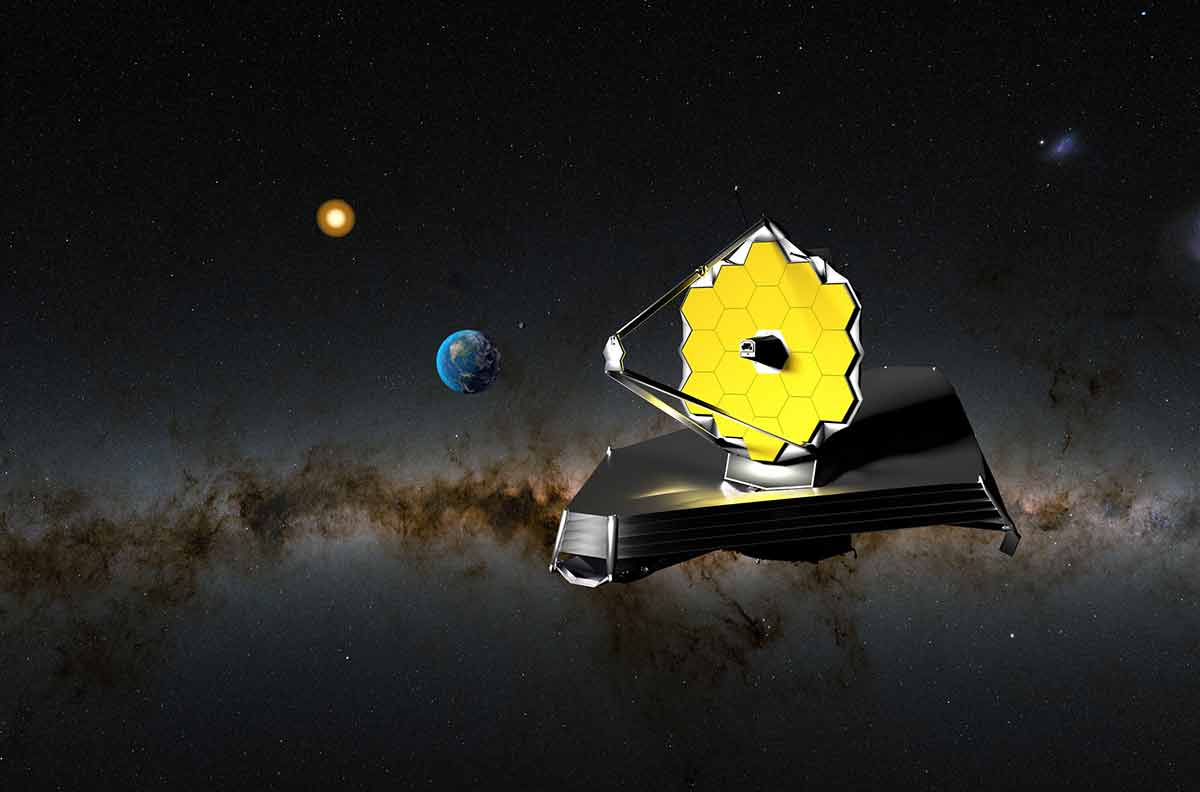
Astronomers at Texas A&M University have found a unique collision involving multiple galaxies in the early universe, challenging previous expectations about galaxy interactions. Using data from the James Webb Space Telescope (JWST), they identified an ongoing merger of at least five galaxies occurring around 800 million years after the Big Bang. This discovery indicates that galaxies were interacting and influencing their surroundings much earlier than previously thought.
Read More
Before the JWST, scientists assumed that complex galaxy mergers would predominantly occur over a billion years after the Big Bang, accompanied by widespread distribution of heavy elements. However, this research suggests that these processes were already active much sooner. Dr. Weida Hu, the study's lead author and a postdoctoral researcher, along with Dr. Casey Papovich, a professor of physics and astronomy, reported their findings in the journal Nature Astronomy.
The newly discovered system, labeled “JWST’s Quintet,” showcases multiple galaxies within a compact area and surrounded by a halo of oxygen-rich gas. Dr. Hu remarked that finding numerous galaxies merging so early in the universe's history was unexpected, given that earlier assumptions considered galaxy mergers to involve only two or three galaxies.
The system was identified in data from the JWST Advanced Deep Extragalactic Survey, one of the most extensive imaging efforts undertaken by JWST. Although these galaxies are separated by tens of thousands of light-years, they occupy a surprisingly small region and are forming stars at a rate approximately 250 times the mass of the sun per year, significantly higher than typical rates for galaxies of that era.
Additionally, researchers detected a halo of glowing gas connecting several galaxies, emitting light from ionized oxygen and hydrogen. This gas lies outside the galaxies, indicating that elements like oxygen, produced inside stars, were expelled during the merger. The analysis indicates that gravitational interactions primarily drove this enrichment, rather than solely galactic winds, providing evidence that galaxy collisions actively shaped their environments in the young universe.
Dr. Papovich highlighted the importance of this discovery for understanding discrepancies between theoretical models and actual observations from JWST. By demonstrating that complex merger systems existed at such an early stage, it suggests that existing theories regarding how galaxies assemble need to be reassessed.
This research may also help explain the increasing number of massive, seemingly inactive galaxies observed by JWST just a few billion years later. If systems like JWST’s Quintet merged quickly and depleted their gas early, they could evolve into the massive galaxies noted at later times. Future observations from JWST are planned to further investigate the motions of gas and galaxies within this system, enhancing our understanding of early cosmic structure formation.
Other Texas A&M contributors to the study include Dr. Lu Shen, Dr. Justin Spilker, and Ph.D. student Justin Cole. This research received funding from the National Science Foundation, the Kavli Institute for Theoretical Physics, NASA, and Marsha and Ralph Schilling.