The Moon lacks a global magnetic field today, but remnants of its ancient magnetism are preserved in lunar rocks and soil. By studying the magnetic minerals within these materials, scientists can reconstruct the Moon's historical magnetic environment.
Read More
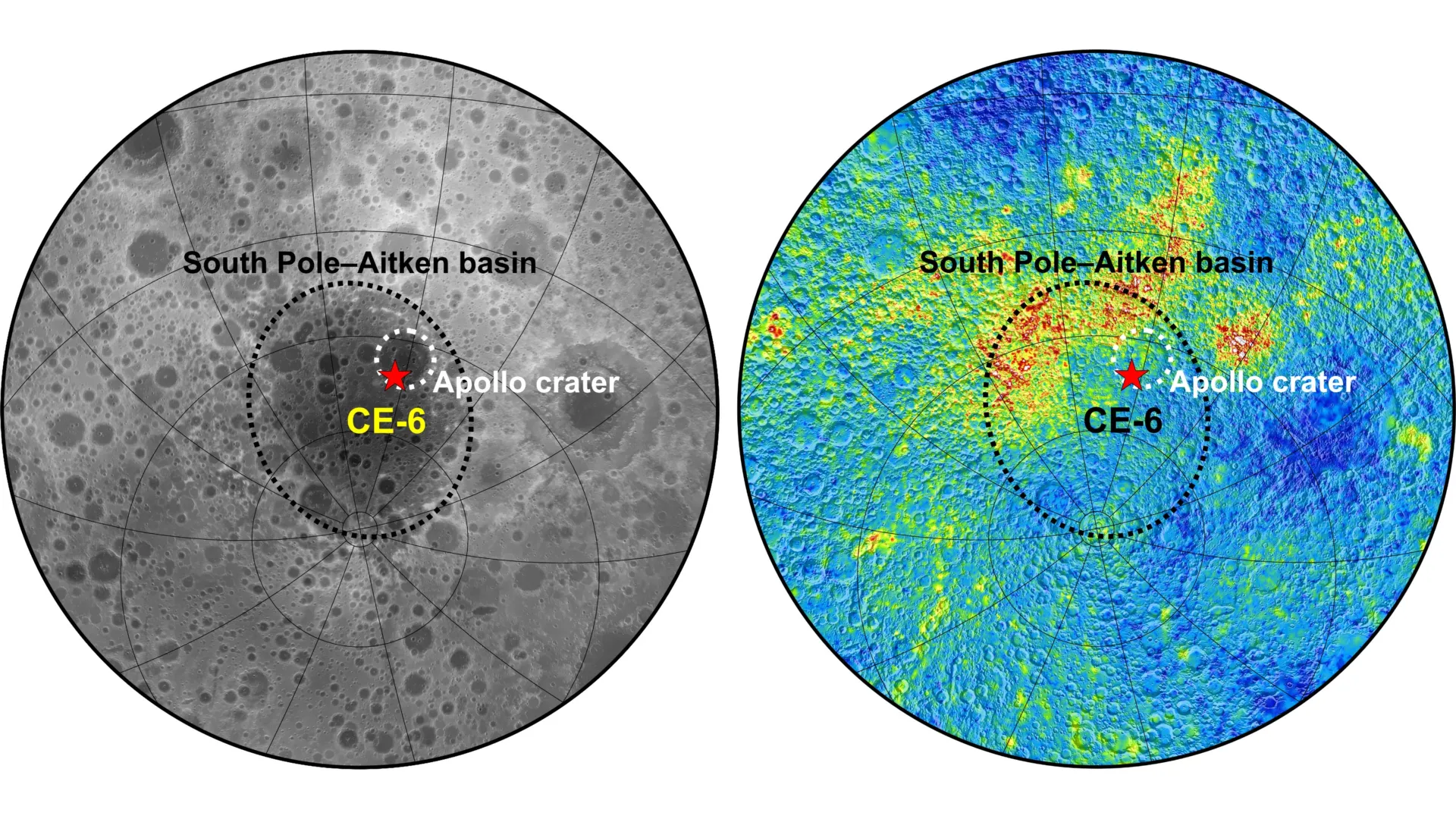
Researchers from the High Magnetic Field Laboratory at the Hefei Institutes of Physical Science (HFIPS), part of the Chinese Academy of Sciences (CAS), have analyzed metallic iron in impact glass from the Chang’e-6 lunar soil. They identified face-centered cubic γ-Fe in natural lunar samples for the first time. The study, led by Prof. Haifeng Du, was published in the Proceedings of the National Academy of Sciences (PNAS) on September 16.
Dr. Long Li from HFIPS remarked that this discovery of a tiny magnetic fossil could enhance understanding of the Moon's ancient magnetic history.
To analyze the samples, the team used focused ion beam preparation, transmission electron microscopy, and chemical analysis, uncovering numerous nanoscale iron particles within the glassy material. Some of these particles were face-centered cubic γ-Fe, which dominated the two impact-glass samples examined.
Under normal conditions, γ-Fe is stable only at high temperatures and typically transforms into α-Fe as the material cools. However, the researchers suggested that the unique conditions resulting from lunar impacts might allow γ-Fe to remain stable at the surface. They proposed that stabilization factors could include trace amounts of carbon and other elements, rapid cooling of molten impact material, and the protection provided by the surrounding glassy matrix.
The research team applied off-axis electron holography to study the magnetic properties of individual γ-Fe nanoparticles. Their findings indicated that larger γ-Fe particles could maintain a stable single-vortex magnetic state and exhibited a consistent magnetic response to external fields. This stability suggests that γ-Fe may serve as a previously unrecognized recorder of magnetic information, preserving insights into the conditions of the Moon's past.
This discovery enriches the variety of known magnetic minerals in lunar samples. Since γ-Fe and α-Fe form under different conditions and exhibit different magnetic behaviors, each could inform scientists about distinct stages of lunar impact events. Further research is needed to fully understand the extent to which these minerals can reveal information about the evolution of the Moon's ancient magnetic field.