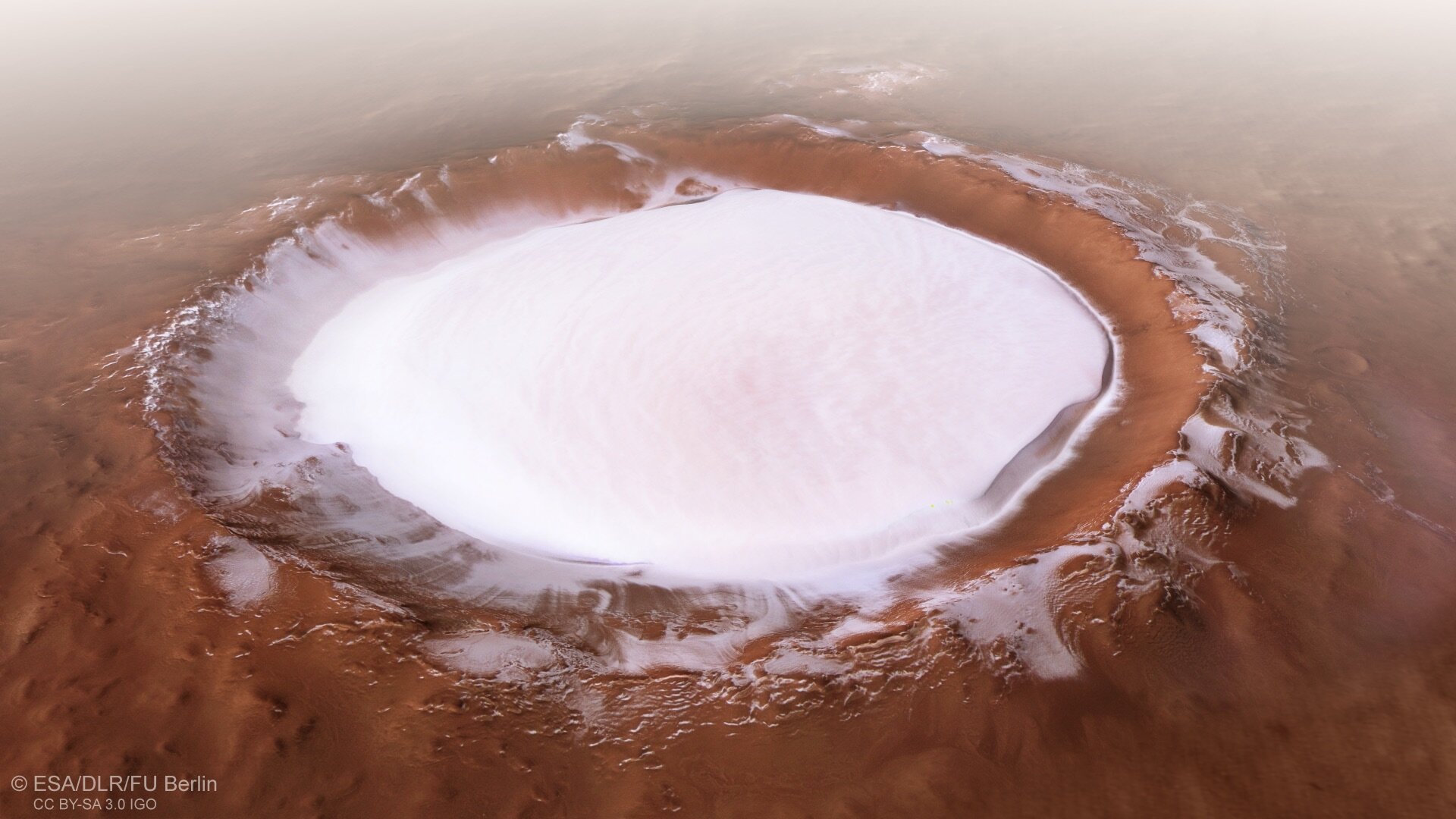
Images taken by the Mars Express High Resolution Stereo Camera show the Korolev crater near the north pole of Mars, combining data from five different orbits. The European Space Agency and partners contributed to this research.
Read More
Mars has a harsh environment, but features such as ice-bound water have drawn scientific interest. These ice deposits contain important records of the planet's past climate, which may shed light on the potential for life.
Most of Mars' ice is obscured by a thick layer of dust, which influences the planet’s climate by decreasing the amount of sunlight reflected into space. A study from the University of Washington, published in npj Space Exploration, indicates that the north pole has less dust than previously estimated.
Aditya Khuller, a senior research scientist at the University of Washington's Applied Physics Laboratory, noted that while water ice is present near the north pole, there has been considerable debate regarding the dust levels on that ice. Dustier ice would absorb more heat, accelerating its vaporization.
To understand Martian climate history, researchers often rely on methods established through studying Earth's polar ice. The National Aeronautics and Space Administration (NASA) marked its first successful mission to Mars 50 years ago. In 2008, the Mars Phoenix mission succeeded in collecting ice samples, which provided crucial data for this recent study.
Khuller previously identified inconsistencies in ice property analyses. He shifted from a lunar soil analysis method to one more appropriate for studying snow and ice on Earth, developed by UW professor emeritus Steve Warren.
The findings suggest the polar region resembles an