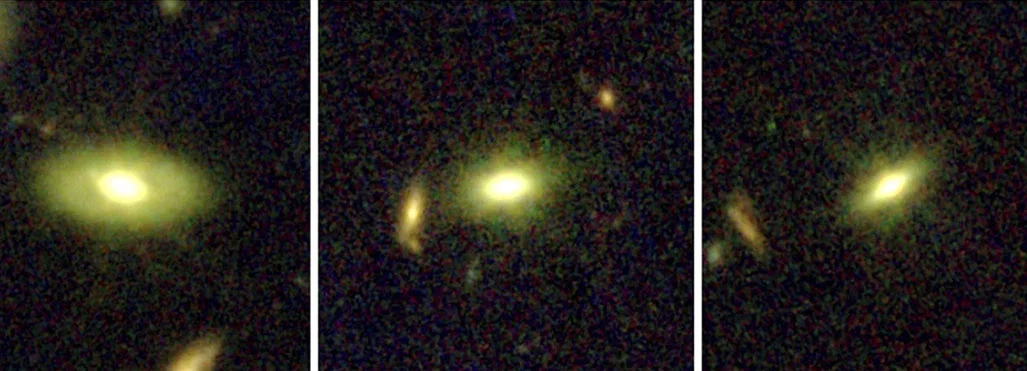
Data from the James Webb Space Telescope (JWST) has unveiled previously undetected stars that are significantly increasing the mass of early galaxies. This discovery, reported by a team from Leiden University in the Netherlands and published in Nature Astronomy, challenges earlier assumptions about the early universe.
Read More
Astronomers focused on nine massive galaxies that had completed their main period of star formation, utilizing JWST's deep cosmic observations alongside earlier data from the Very Large Telescope in Chile. Spectroscopy from JWST allowed the researchers to analyze distant stars and their planetary atmospheres, although detecting smaller stars proved more difficult due to their faintness compared to brighter stars.
Chloe Cheng, the first author of the study, likened the brightest stars in a galaxy to skyscrapers in a city, stating that many smaller stars lie behind them, like houses, indicating that galaxies are more massive than previously estimated.
Researchers initially struggled to detect smaller stellar objects due to limitations in data sensitivity and assumed a consistent ratio of small to large stars across the universe. However, this recent study revealed that these ancient galaxies contain a far greater number of small stars than previously thought, leading to mass estimates that are four times higher for galaxies under 1.5 billion years old compared to prior assessments.
Co-author Martje Slob remarked on the advancements in technology that made these measurements possible, noting that high-quality spectra and improved analysis techniques were essential for distinguishing the subtle light of smaller stars from that of brighter ones.
Since its launch nearly five years ago, JWST has consistently exceeded astronomers' expectations, revealing that the universe shortly after the Big Bang was more developed and had more mass than previously believed. Professor Mariska Kriek, the study lead, emphasized the significance of the findings, stating that the unexpected abundance of small stars could imply a greater number of planets orbiting them.
Looking ahead, the research team plans to extend their observations even further back into the universe's history to study some of its earliest stars. The study, titled “Hidden Mass in Early Galaxies Revealed by Bottom-Heavy Initial Mass Functions,” was published on August 18, 2026.