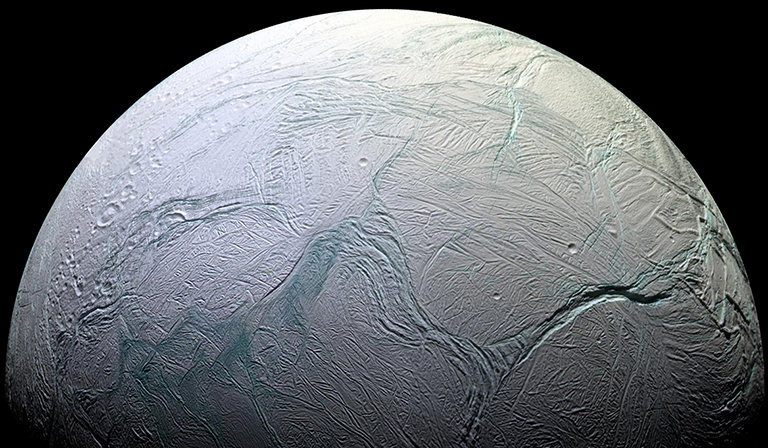
A recent study led by Frank Postberg, a professor of planetary science at Freie Universität Berlin, provides new insights into the potential for extraterrestrial life on Saturn's moon Enceladus. Collaborating with an international team, Postberg's research, published in Science Advances, indicates that determining the constituents of the moon's hidden ocean is simpler than previously thought.
Read More
In a related study published the same day, Postberg and Dr. Nozair Khawaja, also from Freie Universität, revealed that certain microorganisms might be more resilient to the conditions in Enceladus's ocean than earlier studies suggested. These findings bolster the likelihood of uncovering evidence of life on the moon.
Enceladus is regarded as one of the most promising locations in the solar system to search for extraterrestrial life due to its subsurface ocean, which is believed to be a global body of liquid water lying beneath its icy crust. Cryovolcanic activity allows enormous plumes to jet from the moon's southern pole, ejecting ice particles into space. NASA's Cassini spacecraft has sampled these plumes several times, revealing the presence of salts and organic compounds, suggesting hydrothermal processes that could support life.
Postberg's study details how droplets from the ocean's surface, formed by rising gas-filled bubbles, travel through the icy crust into space. Contrary to prior beliefs that these droplets freeze instantaneously, the new research demonstrates they freeze slowly, enabling the separation of components, including salts and organic materials. This segregation means that ice particles often consist of single, concentrated substances.
Postberg noted that this natural separation process facilitates the identification of biosignatures—indicators of life—in frozen droplets. "Enceladus does a lot of the work for us in preparing samples for analysis that usually take significant effort in chemical labs on Earth," he stated, suggesting that future missions could more easily identify signs of life by analyzing individual particles from the ice plumes.
On the same day as Postberg's study, researchers from Ludwig-Maximilians-Universität München published findings regarding the geochemical conditions of Enceladus's ocean, showing that the environment could sustain methane-producing microorganisms known as Methanothermococcus okinawensis. By recreating the ocean's low oxygen, high carbonate, and alkaline conditions in a laboratory, the researchers found that these microorganisms could adapt their metabolism to thrive under such extreme conditions.
Overall, these two studies offer significant insights into the potential for life on Enceladus, suggesting that future missions, such as the European Space Agency's planned L4 mission, may succeed in detecting microbial life if it exists beneath the moon's icy surface.