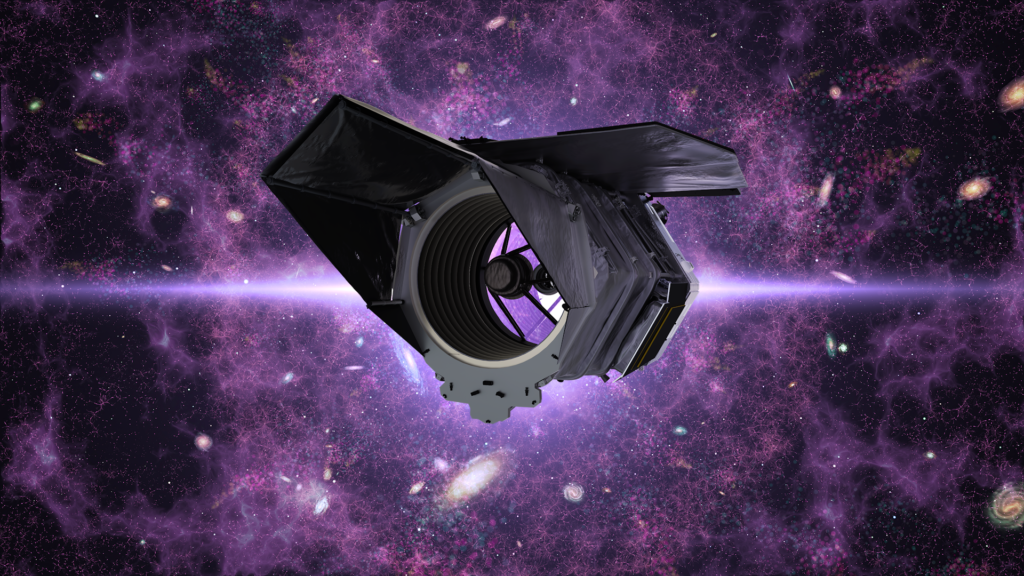
NASA is preparing to launch the Nancy Grace Roman Space Telescope, which will survey a billion galaxies to study the evolution of the universe. The telescope, originally developed by the National Reconnaissance Office (NRO), was transferred to NASA in 2012 after the NRO no longer required it for future missions. Over a decade of modifications have been made, with a potential launch date as early as August 30, 2026.
Read More
The Roman Telescope aims to address significant questions in astrophysics. It is designed to investigate dark matter, which, while not directly observed, influences the behavior of visible matter in the universe. The telescope will also study supernovae to help astronomers measure the universe's expansion rate. Dark matter and dark energy, which together account for the majority of the universe's energy, remain largely mysterious.
The telescope will monitor variations in starlight near the Milky Way's center to detect rogue planets that pass in front of stars. As a planet obscures the light of a distant star, it confirms the planet's presence by causing a brief light perturbation. Additionally, Roman is equipped with a coronagraph, a device that blocks starlight to allow astronomers to study fainter planets around other stars.
A key advantage of the Roman Telescope's design is its wide field of view, inherited from its spy camera origins, enabling it to capture larger areas of the sky compared to previous telescopes like Hubble. While Hubble focuses on narrow fields, Roman can image a large portion of the sky simultaneously, enhancing its observational capabilities.
NASA has incorporated advanced technology into Roman, including a large focal plane consisting of 18 wide-area near-infrared detectors, which are similar to those used in the James Webb Space Telescope. These detectors collectively provide around 300 megapixels of coverage, significantly enhancing the telescope's ability to capture faint astronomical objects.
The anticipation surrounding Roman stems from the historical successes of similar technologies. Significant discoveries in astrophysics, including the inference of dark energy, have leveraged advances in detectors developed over decades. The 2011 Nobel Prize for dark energy research, for instance, relied on sensitive digital imaging technologies.
As Roman prepares for its mission, NASA is also planning its successor, the Habitable Worlds Observatory, aimed at imaging Earth-like planets around nearby stars. The astronomical community eagerly awaits Roman's launch, hoping for successful operations and groundbreaking discoveries in the field of astronomy.