While many consider a day to be a fixed 24 hours, Earth's rotation actually varies slightly. These variations, measured in milliseconds, can lead to some days being longer or shorter due to changes occurring deep within the planet.
Read More
Scientists have long been aware that the rotation speed of Earth's liquid core is not constant. Over the past thirty years, disruptions in the planet's magnetic field have shown that the liquid core can accelerate for several decades and then decelerate in subsequent decades.
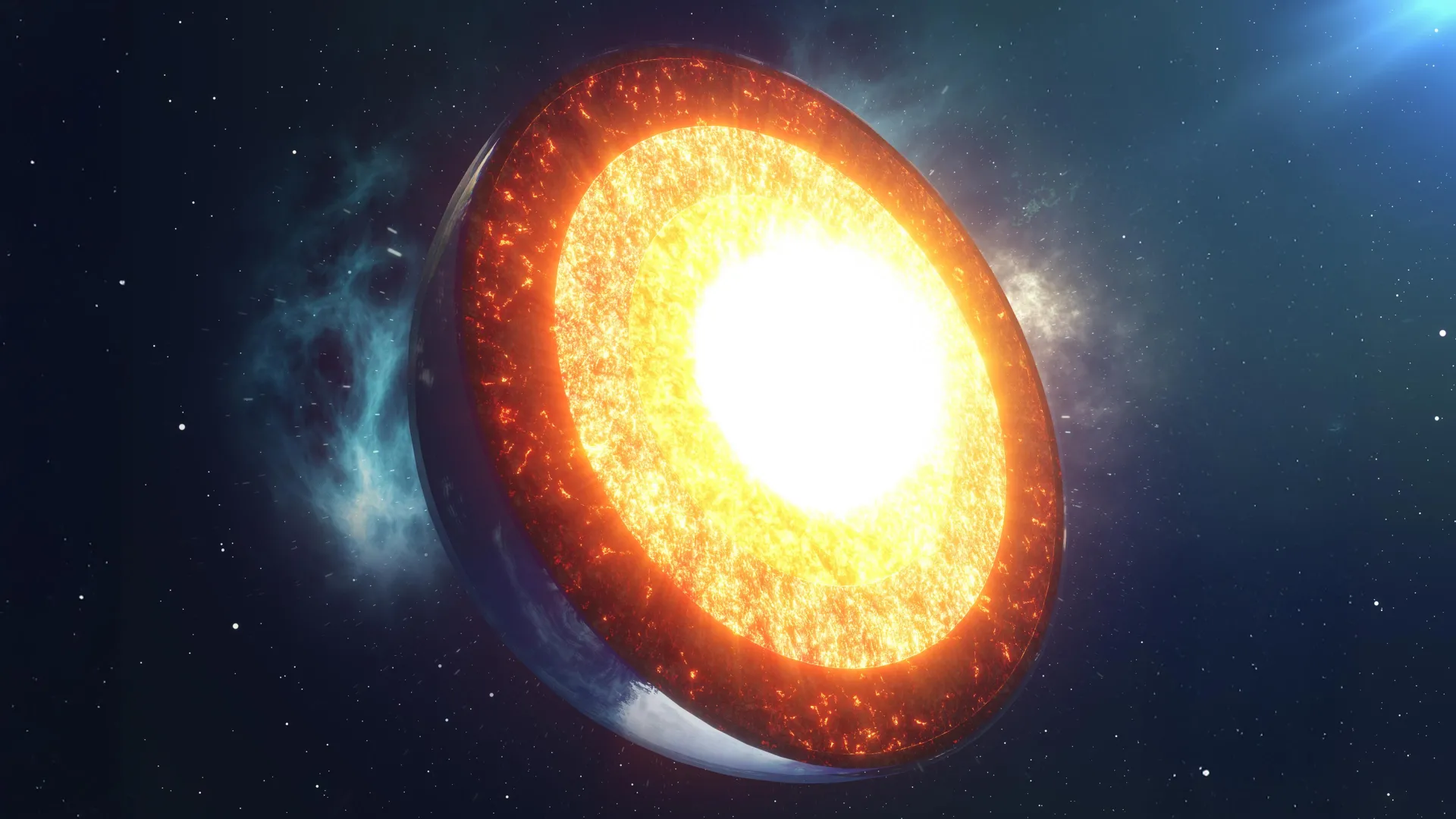
In contrast, the mantle, which is about 3,000 kilometers thick and includes the crust, exhibits opposite behavior. When the core accelerates, the mantle experiences a slight slowdown, and when the core decelerates, the mantle speeds up. This interplay is necessary to maintain Earth's total angular momentum, with even small changes in mantle rotation affecting the length of a day by milliseconds.
A recent study published on September 23 in Nature by Huifeng Zhang, a physics PhD student at the University of Alberta, and professor Mathieu Dumberry proposes a possible mechanism for this exchange of rotational momentum. Their research indicates that alterations in the rotational speed of Earth's solid inner core can generate what is known as "gravitational torque." Since the inner core is not perfectly spherical, changes in its motion can interact with mass distributions in the mantle, subtly impacting its rotation speed and, consequently, the length of a day.
Additionally, another force known as core mantle boundary torque acts at the interface between the core and mantle. This force produces friction and electromagnetic drag, opposing the gravitational torque, thereby limiting the extent of changes in day length. The researchers suggest that the observed variations in day length stem from delicate shifts in the balance between these two opposing torques.
The study also sheds light on the dynamics of Earth’s inner core, indicating that it may deform over a time scale of about ten years, suggesting a more dynamic response to forces than previously recognized.