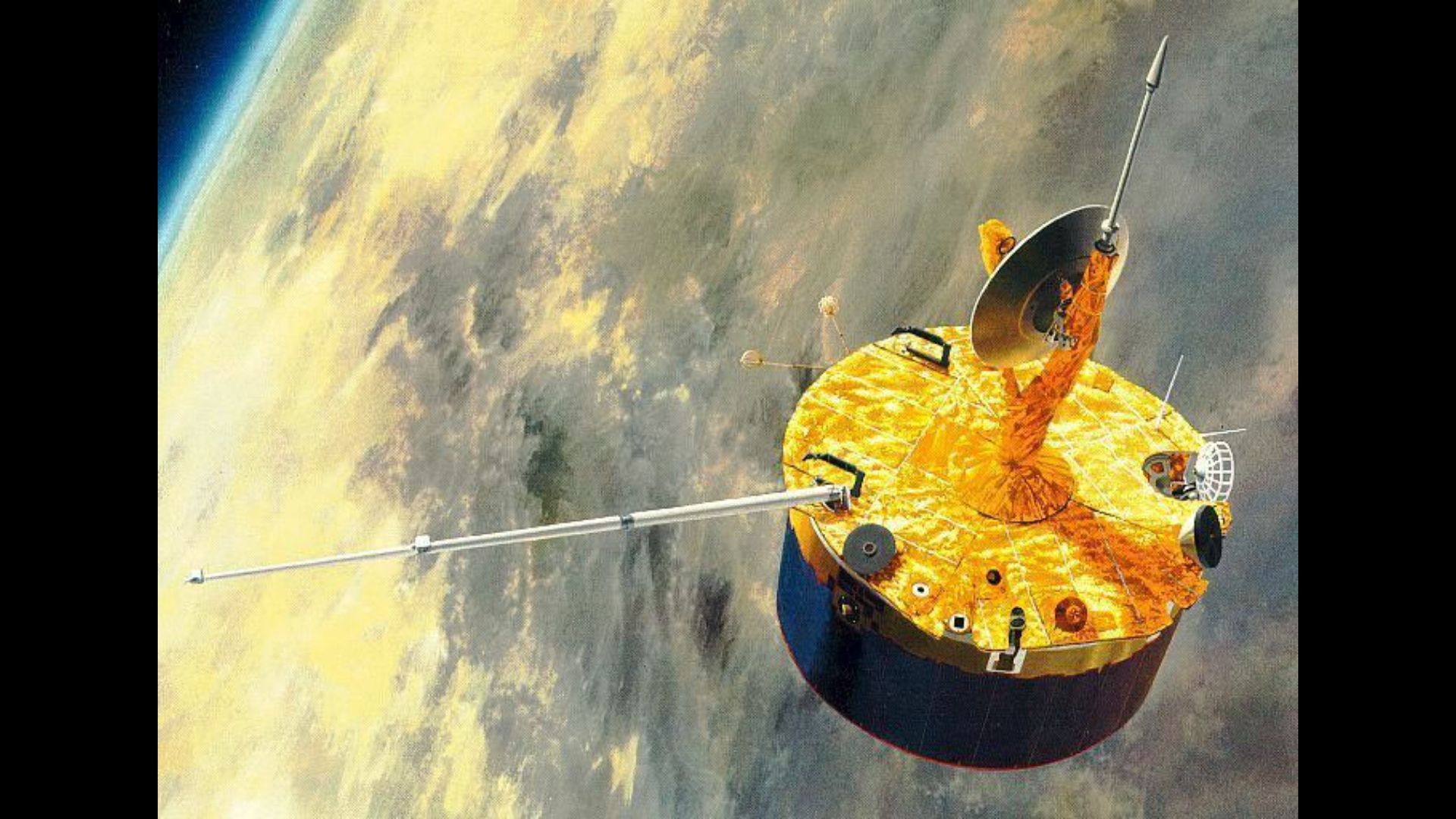
On October 8, 1992, NASA's Pioneer 12 spacecraft, also known as the Pioneer Venus Orbiter, disintegrated in the atmosphere of Venus after 14 years of service. The probe studied Venus's atmosphere, ionosphere, and magnetic field, examining how these interact with solar wind, the stream of charged particles emitted by the sun. It also conducted observations of Halley's Comet during its orbit around the planet.
Read More
Pioneer 12 launched on May 20, 1978, reaching Venus on December 4, 1978. It was the first American spacecraft to enter orbit around Venus, and its mission was part of a series that included a second probe called Pioneer Venus 2, which launched later that same year. The spacecraft was launched from Cape Canaveral, Florida, atop an Atlas Centaur rocket.
Equipped with 16 instruments, Pioneer Venus orbited the planet at approximately 99 miles (160 kilometers). The probe took over 23 hours to complete one orbit. Its instruments mapped the surface of Venus, revealing significant geographical features, including Maxwell Montes, which rises 6.5 miles (10.8 kilometers) above the surface, higher than Mount Everest.
The data collected indicated that Venus has a much rounder and smoother topography than Earth, and cameras on the spacecraft detected near-continuous lightning in its atmosphere. Pioneer Venus also confirmed that the planet has little to no magnetic field.
By March 19, 1981, the probe had mapped 93% of the observable area, prompting NASA to shut off its mapping radar. However, in 1991, new observations led to the reactivation of the radar for further mapping, a remarkable 13 years after the spacecraft's initial launch. Pioneer Venus was not limited to studying Venus alone, as it also documented several comets, including Encke in 1984 and Giacobini-Zinner in 1985, among others.
Hanneke Weitering is a multimedia journalist residing in the Pacific Northwest, reporting on aviation and previously serving as the Editor for Spaceflight and Astronomy news at Space.com.