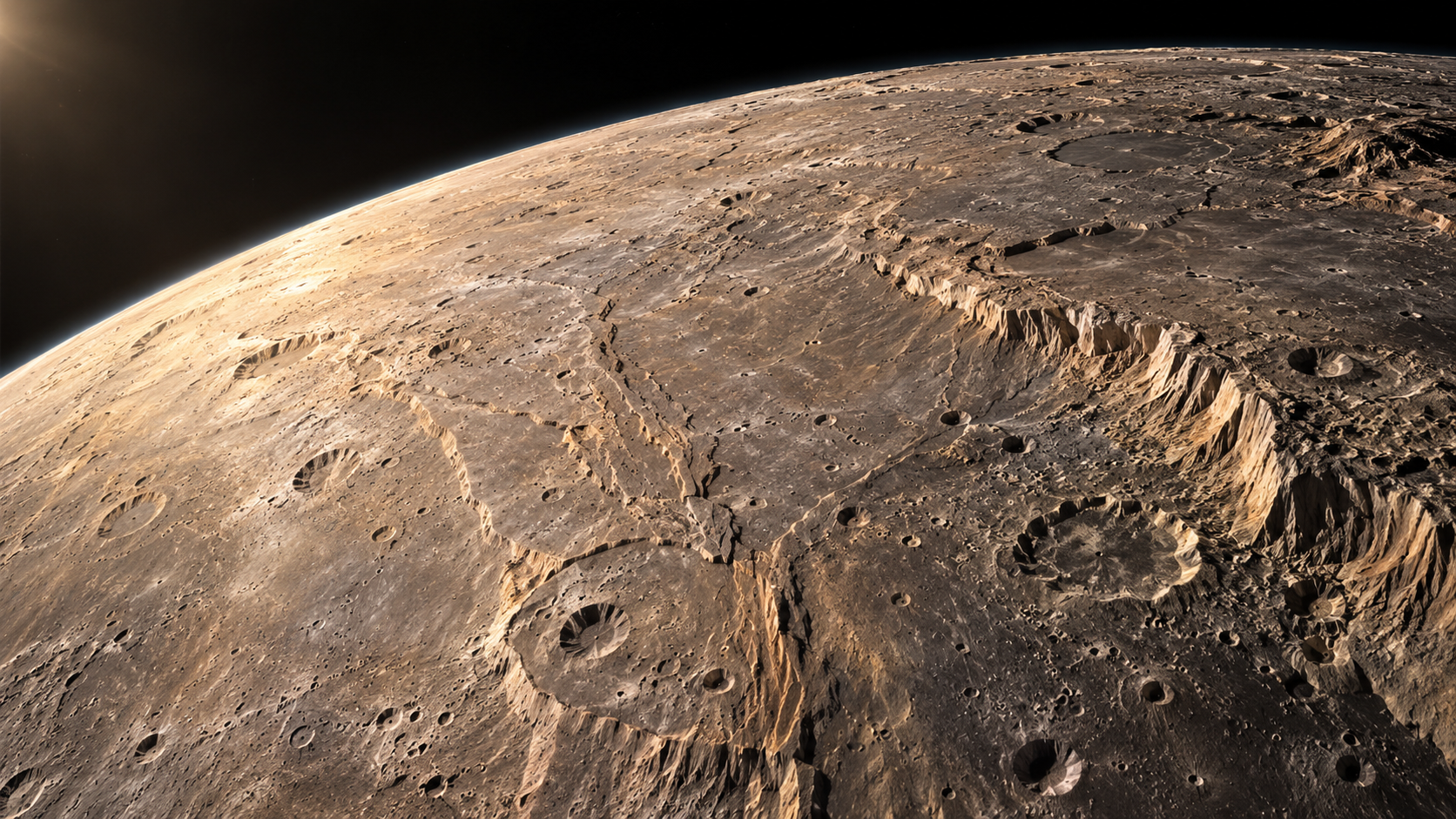
Recent research indicates that Mercury may have contracted significantly more than earlier tectonic estimates suggested, with potential reductions in radial size greater than 10% to 30%. A study published in Geophysical Research Letters reveals that the planet may have lost as much as 11.6 kilometers in radius, translating to a total diameter reduction of approximately 23 kilometers, or 14.5 miles.
Read More
Lead author Gaku Nishiyama from the Institute of Space Research at the German Aerospace Center and the Department of Cosmosciences, Hokkaido University, explained that rough terrain and impact debris could obscure the geological features that demonstrate the planet's contraction. This leads to an underestimation of Mercury's shrinkage, which has occurred over billions of years due to gradual cooling and the resulting interior contraction.
Mercury's surface is marked by scarps, ridges, and other features, which scientists have used to estimate its contraction over time. Earlier estimates of contraction ranged widely, from one to two kilometers up to seven kilometers. However, the new data suggests that the features we rely on to measure contraction have been hidden or obscured by later asteroid impacts. The researchers discovered that rougher areas of the planet had fewer identifiable contractional features, which prompted questions about the traditional assumptions regarding the preservation of Mercury's contractional landscape.
Comparative analysis of global maps showed an anti-correlation between surface roughness and the presence of contraction features. Large impact craters can bury older geologic evidence, and the study pointed out that as new crater ejecta cover older structures, identifying them becomes increasingly difficult. Furthermore, the study highlighted that rough terrain may not only bury these features but also complicate their recognition within the context of the planet’s overall geological activity.
Nishiyama noted that this revised understanding of Mercury's contraction could have significant implications for models concerning its metallic core, chemical composition, and thermal history. Given that more contraction points toward a larger metal core and less mixing of lighter elements, the research prompts a reevaluation of Mercury's interior structure.
While the findings offer a corrected estimate of around 11.6 kilometers of radial contraction, the researchers indicated that this number is a lower limit, hinting that some tectonic structures may remain unobserved. As future observations from ESA and JAXA’s BepiColombo mission become available, they are expected to shed further light on Mercury's surface and potentially reveal the smaller tectonic features that previous missions could not identify.