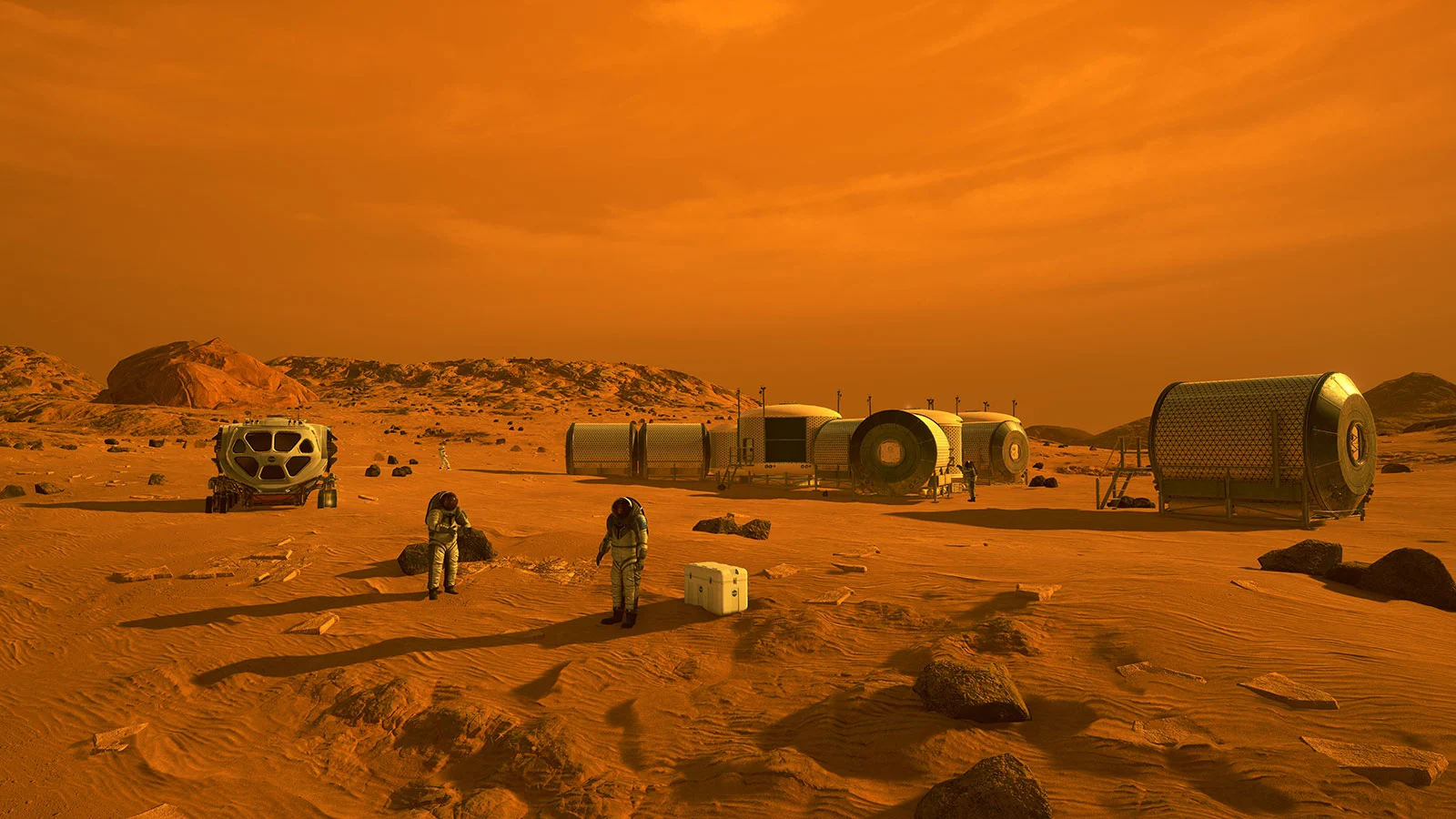
As NASA and China plan crewed missions to Mars in the coming decades, the need for advanced propulsion systems, astronaut health and safety technologies, and in-situ propellant production is becoming increasingly important. Researchers at the Massachusetts Institute of Technology (MIT) are working on technology that could facilitate the creation of refueling depots on Mars, utilizing In-Situ Resource Utilization (ISRU) to manufacture necessary propellant.
Read More
PhD candidate Lanie McKinney and the Aerospace Plasma Group at MIT are developing a method to convert Mars' atmosphere into usable propellant. Their approach employs cold plasma technology to transform carbon dioxide, a prevalent component of the Martian atmosphere, into oxygen and carbon monoxide, which could support both life support systems and refueling stations.
Through MIT's Space Resources Workshop, McKinney has engaged in NASA competitions focused on sustainable living solutions in space. She participated in a challenge to design a self-sustaining Mars mission lasting 10 years. Additionally, in March, she co-led the MIT team that won first prize in NASA's LunaRecycle Challenge for their project, which involved recycling mixed trash into powder for 3D printing, earning the team $775,000.
Under the guidance of Carmen Guerra-Garcia, an associate professor at MIT, McKinney has created a plasma reactor known as the Nanosecond Repetitively Pulsed Dielectric Barrier Discharge (NRP-DBD). This device is designed to extract oxygen from carbon dioxide. McKinney's work currently integrates the reactor with an oxygen-selective membrane for rapid oxygen extraction, although challenges remain in understanding the reactive plasma environment's effects on this process.
McKinney stated, “We can actually perform the conversion step really well. But what happens in a plasma is we convert it, and then we get a mixture that needs to be separated. We are not entirely sure what we will see.”
Another project she participated in involved collaboration between engineers and architects in MIT's Space Architecture course, focusing on constructing protective lunar habitats using local resources. The team's innovative solution was to create modular bricks from lunar regolith that could be stacked without the need for mortar.
Reflecting on her multidisciplinary experiences, McKinney emphasized the importance of collaboration in overcoming the challenges of human space exploration. She noted that building a permanent presence on Mars requires public-private and international partnerships: “If we don’t build gas stations on Mars, it will be very difficult to get humans back to Earth. We’re going to need some way to produce the propellant on site. What comes next is building up a permanent presence so that we can do amazing science and be really effective at exploration.”