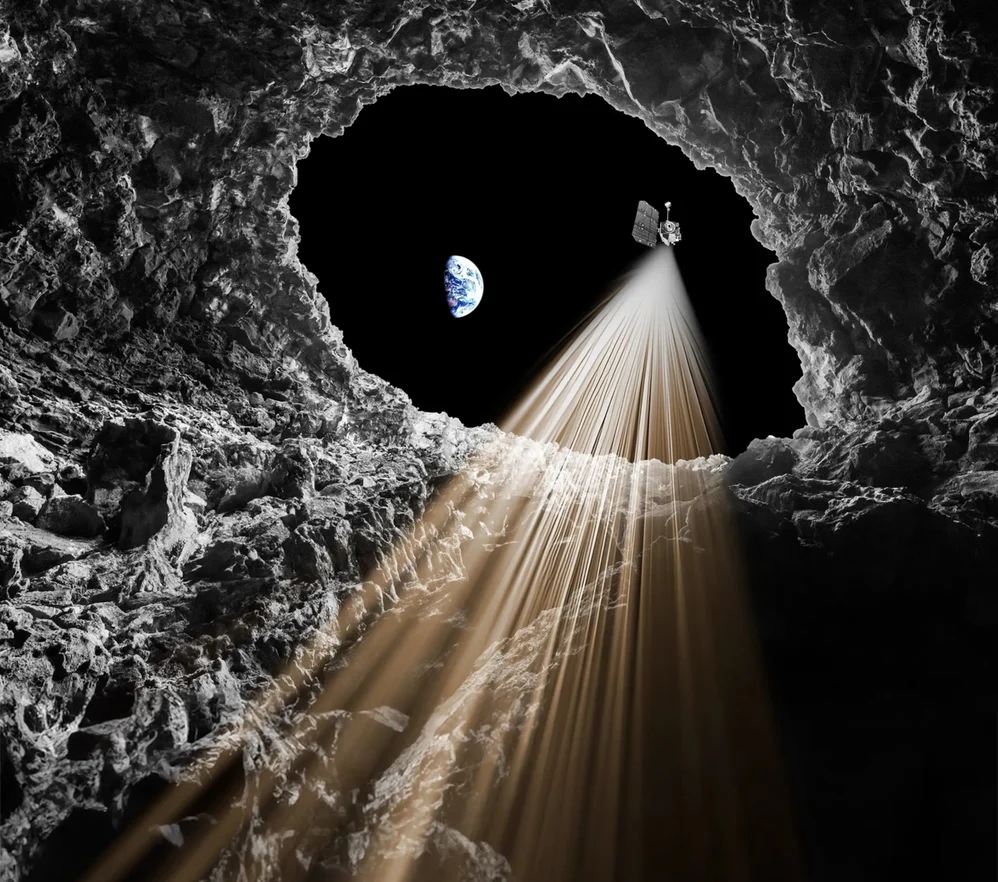
NASA's Artemis Program aims to establish a sustained program for lunar exploration and development, which includes returning astronauts to the Moon for the first time since the Apollo Era. As part of this initiative, NASA is looking at the potential of lunar caves as suitable sites for habitats and other facilities.
Read More
To facilitate this exploration, the Geophysical Instruments for Marius Lunar Pit Investigation (GIMLI) will be deployed, spearheaded by the Planetary Science Institute (PSI). GIMLI's main objective is to examine a ‘skylight’—a hole in an ancient lunar lava tube—to determine if a larger cave system exists beyond it, which could serve as a safe operational area for astronauts in the future.
The mission will be led by Than Putzig, Associate Director and Senior Scientist at PSI, with the Norwegian Space Agency as a key partner. Equipment and instrumentation will be developed by Honeybee Robotics, while NASA will provide a lander and rover through its Commercial Lunar Payload Services (CLPS) and fund the mission via its Payloads and Research Investigations on the Surface of the Moon (PRISM) program.
Amanda Hendrix, PSI Director and CEO, stated that GIMLI embodies ambitious planetary science, enabling a direct investigation based on findings from lunar orbit. Observations from lunar orbiters have suggested the presence of underground caves, indicated by surface features like sinuous rilles and skylights, remnants of the Moon's geologically active past.
The GIMLI investigation will focus on the Marius Hill Pit (MHP), located in a volcanically diverse area of the Moon. Similar to other lunar pits, MHP may provide access to these underground spaces formed during ancient volcanic activity. The mission will utilize an array of advanced instruments, including ground-penetrating radar, seismic sensors, a gravimeter, and cameras, to explore and possibly map the pit's dimensions and subsurface properties.
Putzig remarked on the significance of reintegrating seismic methods into planetary science, a practice not employed since the Apollo missions. The combination of seismic techniques with other measurements promises to enhance our understanding of subsurface geology.
Even if GIMLI does not discover an extensive cave system, the data collected could answer crucial questions regarding the formation of MHP. The GIMLI team will explore beyond the pit to gain insights into the region's volcanic history and examine the walls for layers of regolith and lava flows, offering a wealth of information not accessible through orbital observations.
Gareth Morgan, a PSI Senior Scientist and Deputy Principal Investigator for the GIMLI program, emphasized that confirming a significant lava tube would provide valuable insights into lunar volcanism. Identifying these structures would allow scientists to apply terrestrial knowledge of basaltic volcanism to better interpret the Moon’s geological history.