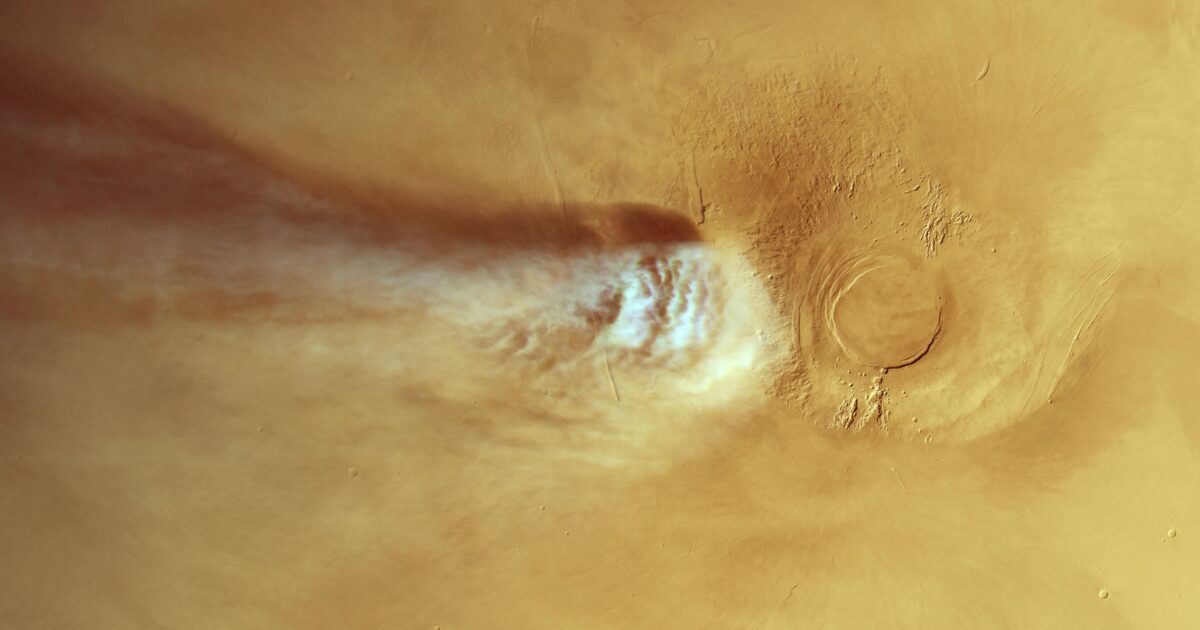
The Arsia Mons Elongated Cloud, a notable feature on Mars that can stretch nearly as long as Italy, has been studied using data from the European Space Agency’s Mars Express orbiter. Researchers have determined that this cloud may form in a unique manner, potentially creating ice directly from water vapor rather than through the coalescence of particles like dust or salt, which is typical for clouds on Earth. The photo accompanying this report was also taken by the Mars Express orbiter.
Read More
Nearby, Arsia Mons is one of the largest volcanoes on Mars and features deep pits on its flanks, some of which may represent cave entrances that warrant further exploration.
In another development, NASA's DAVINCI spacecraft, which is preparing for its mission to Venus, underwent furnace tests in Bedford, Pennsylvania, during August and September. An engineering model of the spacecraft’s atmospheric descent probe was subjected to these tests to simulate the extreme heat experienced during descent through Venus’ atmosphere; the probe successfully passed these trials.
Astronomers have discovered a potential Jupiter-sized planet that may have formed from material expelled by its star as it exhausted its fuel, differing from the formation process of most known planets, which typically arise from leftover material from their host stars.
NASA has outlined plans to incorporate scientific investigations into its future Moon Base endeavors. The agency has selected three proposals which include developing an instrument suite to search for underground lava tubes, conducting experiments to measure surface properties and the presence of water ice, and establishing a monitoring station for seismic activity and environmental conditions.
Additionally, The Planetary Society has released a guide for those interested in hosting sidewalk astronomy events, especially timely as Halloween approaches. This guide provides best practices based on personal experiences and insights from the society’s members.
Innovative ideas for space exploration were discussed in the latest episode of Planetary Radio, featuring interviews with scientists at the 2026 NASA Innovative Advanced Concepts Symposium, where they explored concepts for quicker travel to the outer Solar System and producing oxygen for long-duration space missions.
This month’s book club theme from The Planetary Society centers on cosmic beauty, discussing "The Art of the Cosmos" by planetary scientist Jim Bell. A future session will feature author Annalee Newitz discussing her sci-fi work.
As part of the Egypt 2027 Eclipse sweepstakes, participants can enter for a chance to win Celestron EclipSmart Solar Binoculars. The drawing closes on October 20, and entries also give a chance to win an astronomer-led trip to Egypt for the total solar eclipse.
In the night sky, Saturn can be observed in the early evening, bright Jupiter will rise in the middle of the night, and reddish Mars will appear later in the night and into the morning sky, situated above Jupiter.
The Japan Aerospace Exploration Agency is preparing to launch its MMX mission later this month, aimed at returning the first-ever samples from Mars' moon Phobos. The launch poster for the mission features an orange circle inspired by the Zen concept of “ensō,” symbolizing the Universe and enlightenment.