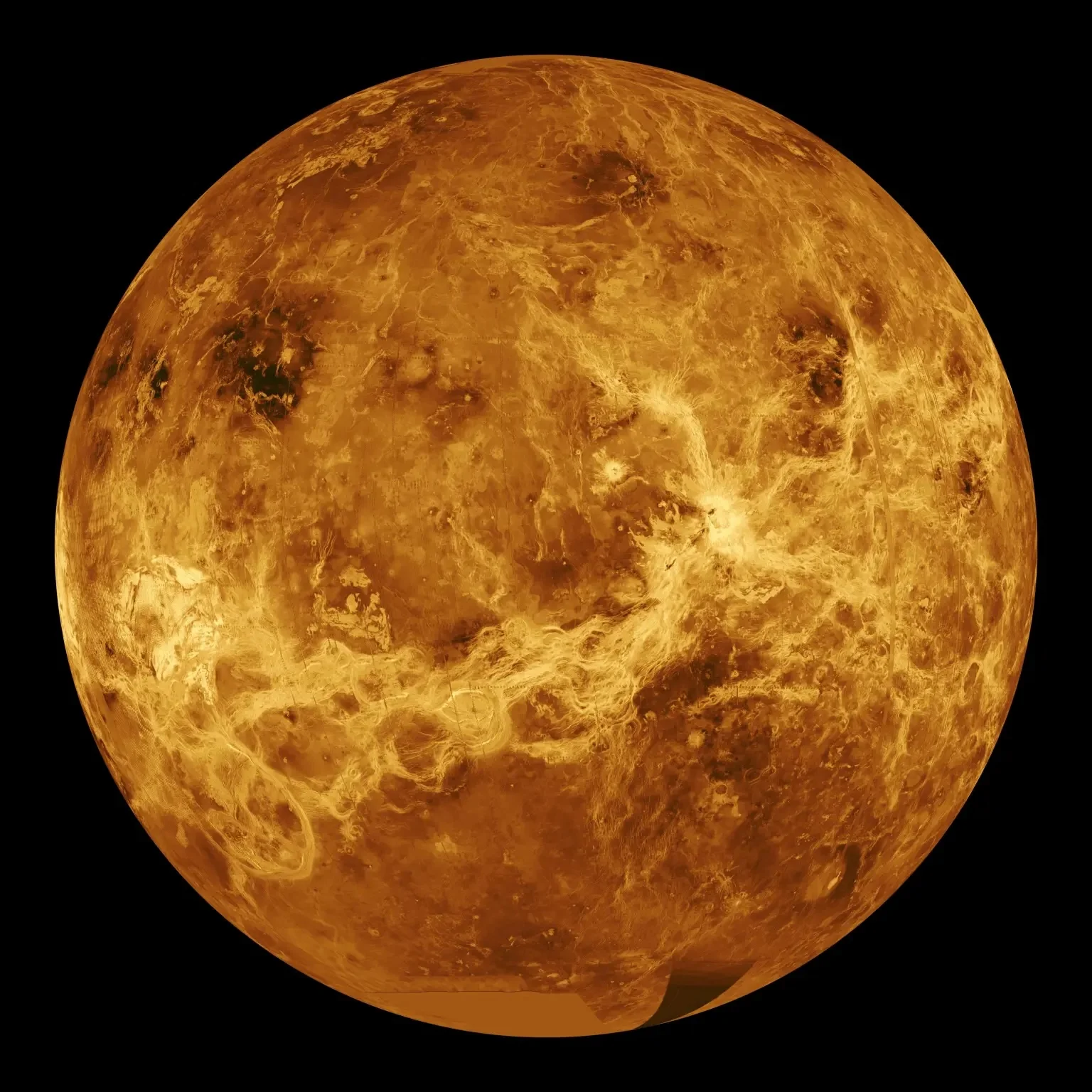
Scientists have established a new theory explaining why Venus, despite its similarities to Earth in size, mass, and structure, lacks a moon. Research from the University of California, Riverside (UCR) proposes that Venus may have consumed a hypothetical moon due to its slower rotation and gravitational dynamics.
Read More
Previous theories suggested that Venus either lost a moon to a catastrophic impact or never formed one. However, the study published in The Astrophysical Journal indicates that neither of these explanations was entirely accurate. Lead author and UCR astrophysicist Stephen Kane stated, "My study shows Venus didn’t require a catastrophe to arrive at what we can see today. The gravity of the planet itself combined with the rate at which it spins naturally caused the moon to collapse on top of it."
NASA's Apollo 11 mission left mirrors on the moon, allowing scientists to measure its distance from Earth, which is increasing at about four centimeters per year due to Earth's relatively fast rotation of 24 hours. In contrast, Venus completes a rotation in 243 Earth days, suggesting that a moon would spiral inward rather than drift away.
Kane's research involved computer modeling of planetary interactions through gravity. He first replicated Earth’s moon formation before testing various scenarios for Venus with hypothetical moons of different masses. In nearly all simulations, regardless of size, the moon spiraled into Venus, and more massive moons collided faster. Kane expressed surprise at the consistency of the results.
While the study does not definitively prove that Venus ever had a moon, it suggests that if one existed, it could not have persisted indefinitely. Finding physical evidence of a collision is challenging, as approximately 80% of Venus' surface dates back to a major resurfacing event around one billion years ago, which erased much of its geological history.
There may still be clues beneath the surface. Similar to how Earth's moon formed after a significant impact, seismic studies of Venus could reveal remnants of such an event. This research could also help clarify whether Venus was ever capable of supporting life. A moon crashing into Venus would have transferred considerable energy and angular momentum to the planet, potentially altering its rotation, geology, and climate.
The implications extend beyond Venus in the search for habitable worlds around other stars, where the presence of a moon can influence a planet's habitability. Kane noted that while having a moon can be beneficial, it isn’t necessary for life. He cautioned that planets similar to Earth might lose their moons if they rotate too slowly, fundamentally altering their evolutionary trajectory.