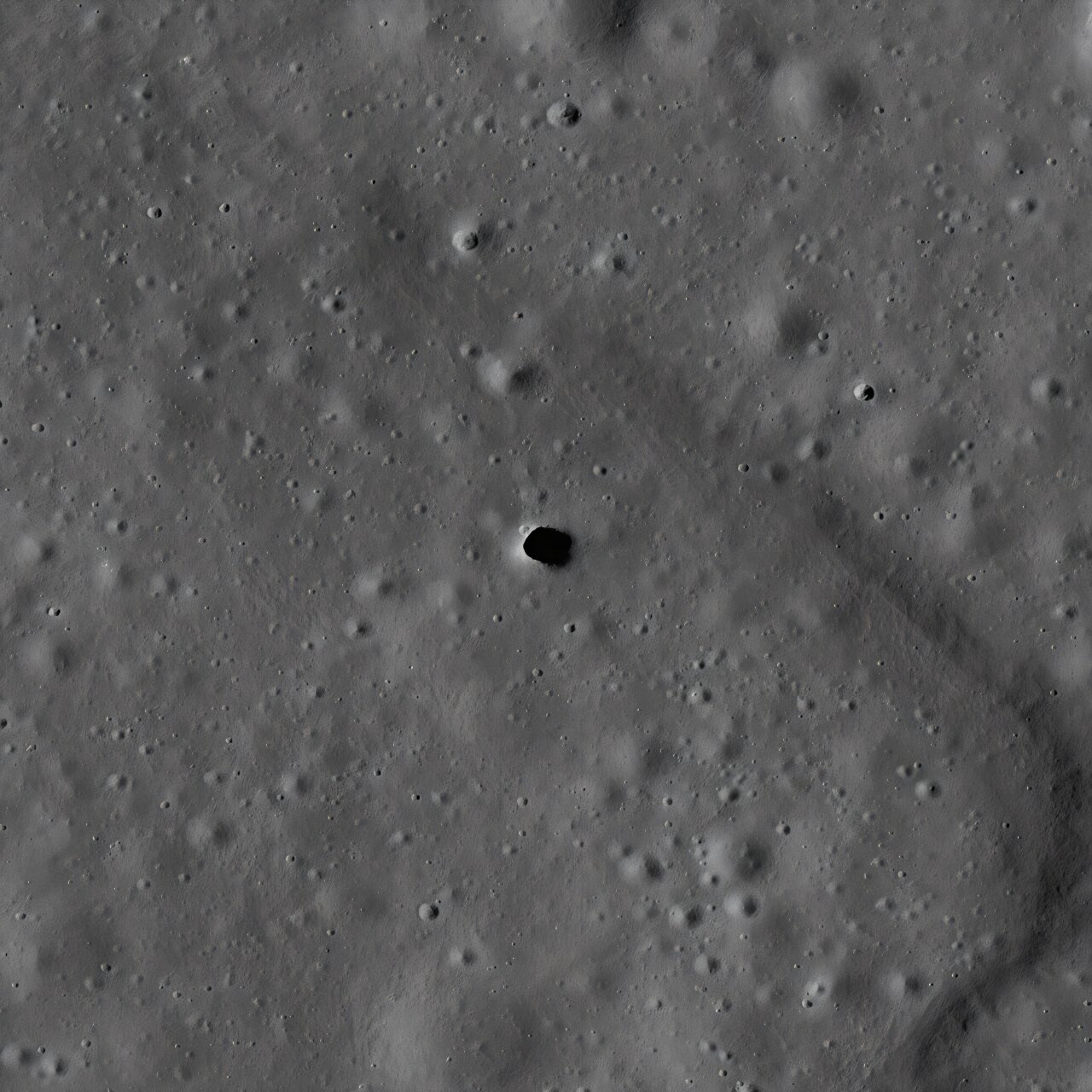
NASA has selected a project led by the Planetary Science Institute (PSI) to explore the potential existence of a significant underground cave linked to the Marius Hills Pit (MHP) on the Moon. This cave could provide astronauts with protection from radiation and extreme temperature fluctuations on the lunar surface.
Read More
The project, named Geophysical Instruments for Marius Lunar Pit Investigation (GIMLI), will be directed by PSI’s associate director and senior scientist Than Putzig. The initiative is a collaboration between PSI and Honeybee Robotics, which will develop much of the necessary equipment for the mission. These instruments will be carried aboard a lander and rover provided through NASA’s Commercial Lunar Payload Services program, with support from the Norwegian Space Agency.
Amanda Hendrix, PSI’s director and CEO, stated that GIMLI embodies the ambitious spirit of planetary science that PSI aims to achieve. She expressed enthusiasm for the collaboration with NASA and Honeybee Robotics, which aims to enhance understanding of the Moon and its volcanic history.
Satellite observations have indicated that caves and lava tubes may be present beneath the Moon's surface. GIMLI will specifically investigate MHP, located in a volcanically active region, as it might serve as an entry point to such underground formations formed by ancient volcanic processes.
Putzig noted his long-held interest in reintroducing active-source seismic methods in planetary science, a technique that has not been utilized since the Apollo missions. Combining these methods with ground-penetrating radar and gravity measurements will allow scientists to gain deeper insights into the subsurface characteristics, potentially identifying a lava tube extending from MHP.
The project will employ ground-penetrating radar, seismic sensors, and a gravimeter to examine the Moon’s surface and the pit walls. Cameras will capture images as part of the investigation, which will attempt to locate an underground void and ascertain its size, if present.
Honeybee Robotics, a subsidiary of Blue Origin, will oversee project management and construct the active-source seismic system, gravimeter, and cameras. They will integrate these instruments onto the lander and rover, as well as coordinate operations on the lunar surface.
Even if GIMLI does not uncover a cave or lava tube, the data collected will still provide insights into the origin of the MHP and the geological history of the region. The study of the pit’s walls, which reveal layers of regolith and lava flows, may shed light on the Moon's volcanic past and the dynamics of lava movement.
Lunar pits are significant not only for their geological formations but also potentially for the historical records of the Moon's volcanic processes found within underground spaces. Gareth Morgan, PSI senior scientist and deputy principal investigator for GIMLI, explained that discovering a substantial lava tube would enhance the understanding of lunar volcanism, offering parallels to basaltic volcanism observed on Earth.
The GIMLI team includes co-investigators from Boise State University, Johns Hopkins University, the Lunar and Planetary Institute, and the University of Oslo, with ground-penetrating radar supplied by the Norwegian Space Agency.