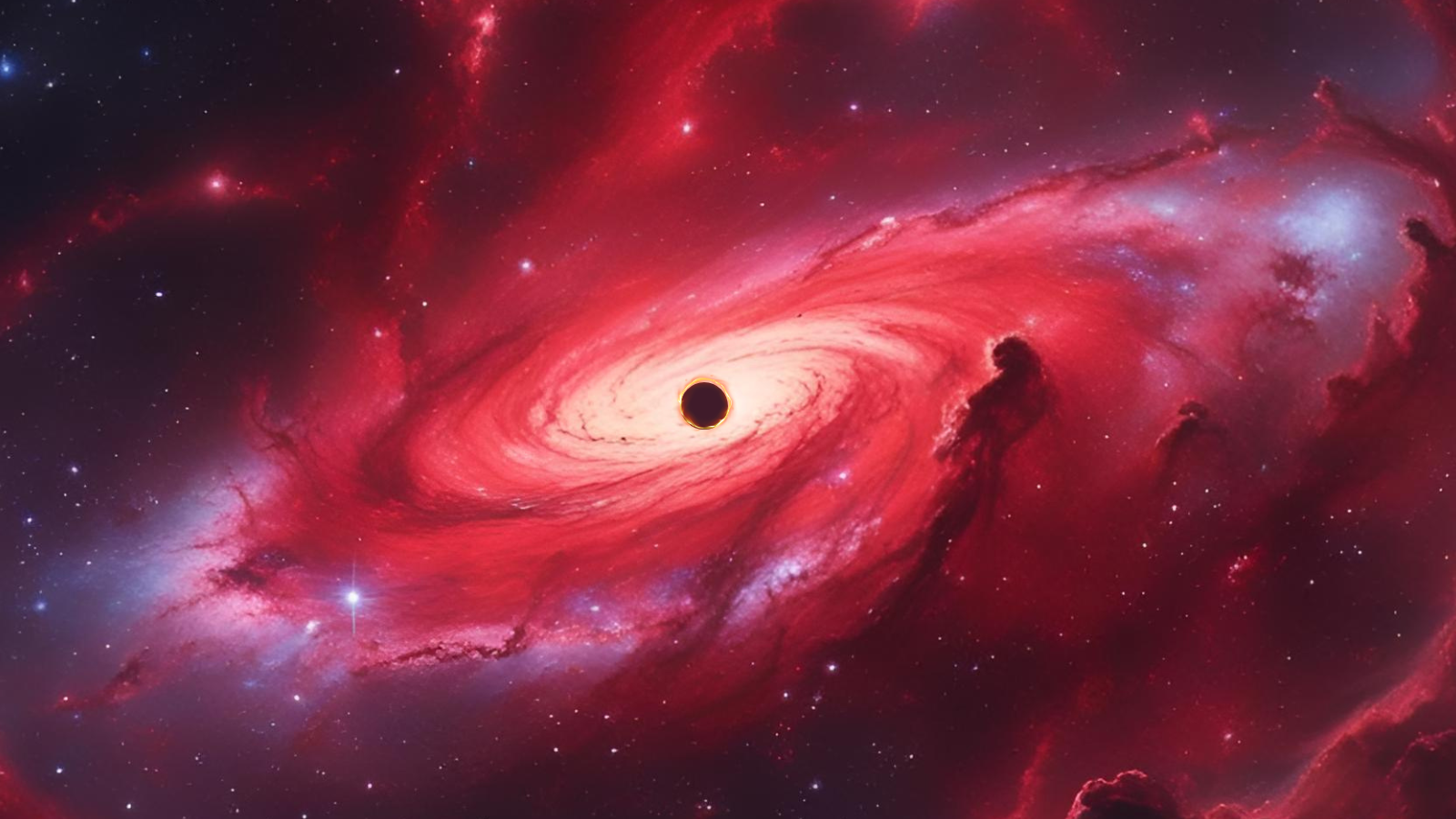
The James Webb Space Telescope (JWST) has identified mysterious objects dubbed 'Little Red Dots,' which may serve as nurseries for massive black holes formed directly from gas clouds, rather than through stellar collapse. This finding could help clarify both the nature of the Little Red Dots and the presence of supermassive black holes appearing shortly after the Big Bang, around 500 million years ago.
Read More
Previously, the formation of supermassive black holes was thought to take over a billion years through a merger-driven process. However, researchers propose that if these black holes begin as 'heavy seeds'—direct collapse black holes from dense regions in gas clouds—then their formation timeline makes more sense within the early universe context. In contrast, 'light seeds' originate from stellar deaths, limiting their initial mass.
Elia Cenci, the research team leader from the University of Geneva, stated that direct collapse black holes could form under specific conditions in dark matter halos, where molecular hydrogen is absent, preventing cooling and favoring smaller star formations. The Little Red Dots emerged when the universe was less than a billion years old and are characterized by their distinct light patterns and compactness.
Cenci noted that their high-resolution simulations indicate a potential link between these objects and direct collapse black holes. If confirmed, this connection could provide the first observational evidence for understanding the formation of the universe's most massive black holes.
Direct collapse black holes can grow significantly larger—as much as a million times the mass of the Sun—right from their inception. This acceleration allows them to develop into supermassive black holes in a relatively short cosmic time frame.
Cenci explained that such conditions for direct collapse are not found in the current universe due to the presence of heavier elements forged from stars, which disrupt the necessary pristine environments for black hole formation.
The Little Red Dots appear to vanish around 1.5 billion years after the Big Bang, suggesting their conditions become unsuitable for direct collapse black hole formation due to the evolution of their environments.
Further observational studies are needed to confirm the role of Little Red Dots in black hole formation and to explore the dynamics and physical state of their dense gas. Cenci and her team continue to conduct simulations to refine their understanding of the early universe and the factors influencing direct collapse black holes. Their research has been published in the Monthly Notices of the Royal Astronomical Society.