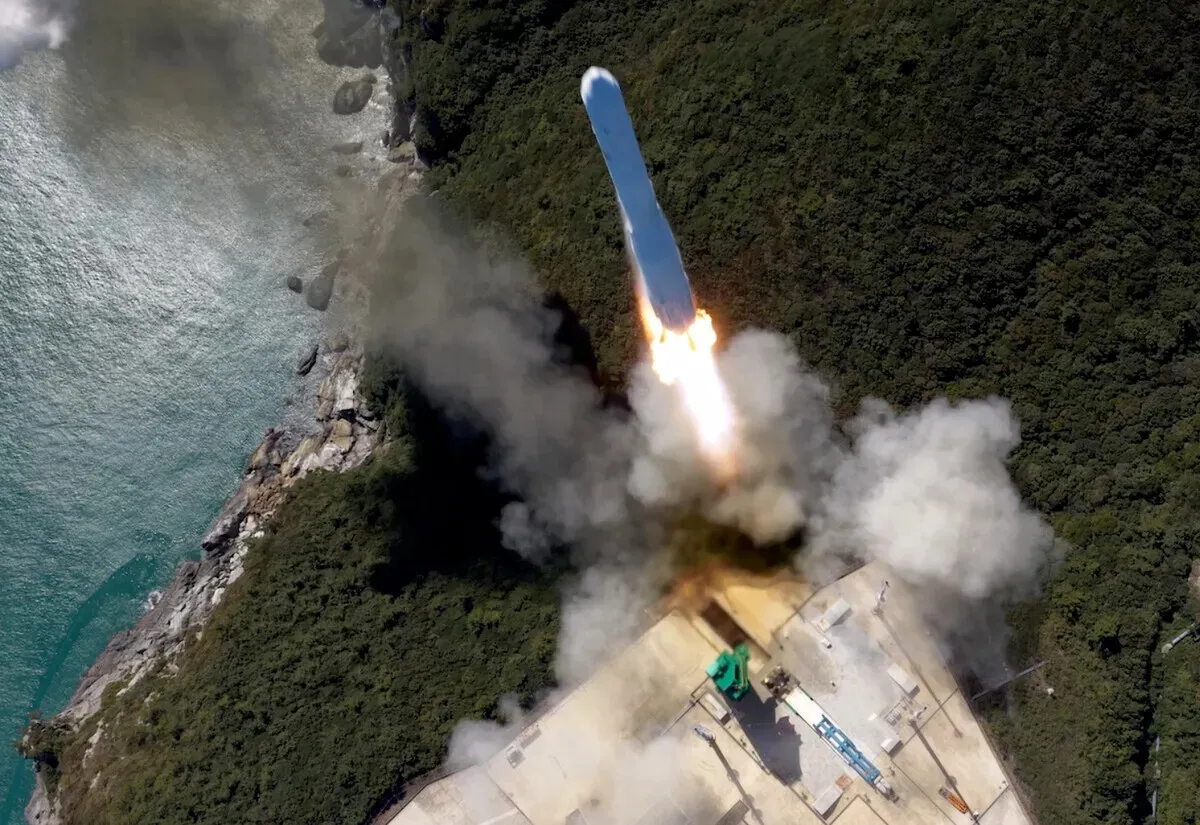
The Korea Aerospace Research Institute (KARI) successfully launched the Nuri rocket for the fifth time on October 7, 2026, from the Naro Space Center in Goheung County, South Jeolla Province. The launch occurred as scheduled at 12:25 pm, with the first stage separating after 2 minutes and 1 second at an altitude of 66.5 km, and the fairing separating at 3 minutes and 51 seconds at 227 km.
Read More
During this mission, five microsatellites—the primary payload—began separating at 13 minutes and 15 seconds in intervals of 35 to 40 seconds from an altitude of 576 km. Additionally, nine CubeSats were deployed at an altitude of 579 km at 16 minutes and 20 seconds. However, one CubeSat, PERSAT02, intended for monitoring marine debris around Jeju, failed to separate. Oh Tae-seog, the administrator of the Korea AeroSpace Administration (KASA), emphasized that this issue was unrelated to the overall performance of the launch.
This launch was significant as it marked the first deployment of a satellite constellation by the Nuri rocket, aligning South Korea with global trends in space. Unlike the previous fourth launch, which carried a single satellite, this mission utilized KARI's newly developed low-shock satellite separation mechanism to deploy five microsatellites weighing approximately 100 kilograms each.
The latest Nuri launch successfully continued a streak of four consecutive satellite deployments, improving the overall success rate of the Nuri rocket from 75% to 80%. KASA aims for a cumulative success rate of 90% or higher to strengthen South Korea's position in the global commercial launch market.
Oh indicated future plans for the Nuri rocket to support locally produced satellites previously launched using foreign rockets. With a total of five launches planned, including two more in 2027 and 2028, the initiative signifies a shift towards privatization in South Korea's launch services, with Hanwha Aerospace expected to lead operational processes starting with the eighth launch.
In anticipation of increased demand, the South Korean government plans to enable two to three annual launches by transitioning to a private commercial launch model by 2030. Oh stressed the necessity of attaining a 90% success rate through consistent launch activity. Future developments in next-generation launch vehicles will likely incorporate reusable rocket technology, aimed at reducing launch costs significantly. The government currently invests 2.29 trillion won in developing a methane-fueled two-stage rocket, targeting a test flight by 2031.
Looking ahead, South Korea aims to launch a lunar lander in the 2030s, using the Nuri rocket to deploy an initial small lander developed in collaboration with the private sector, followed by a national lunar lander planned for 2032. While still in the early stages of developing reusable technology, the progress marks a promising step in South Korea’s space exploration efforts.