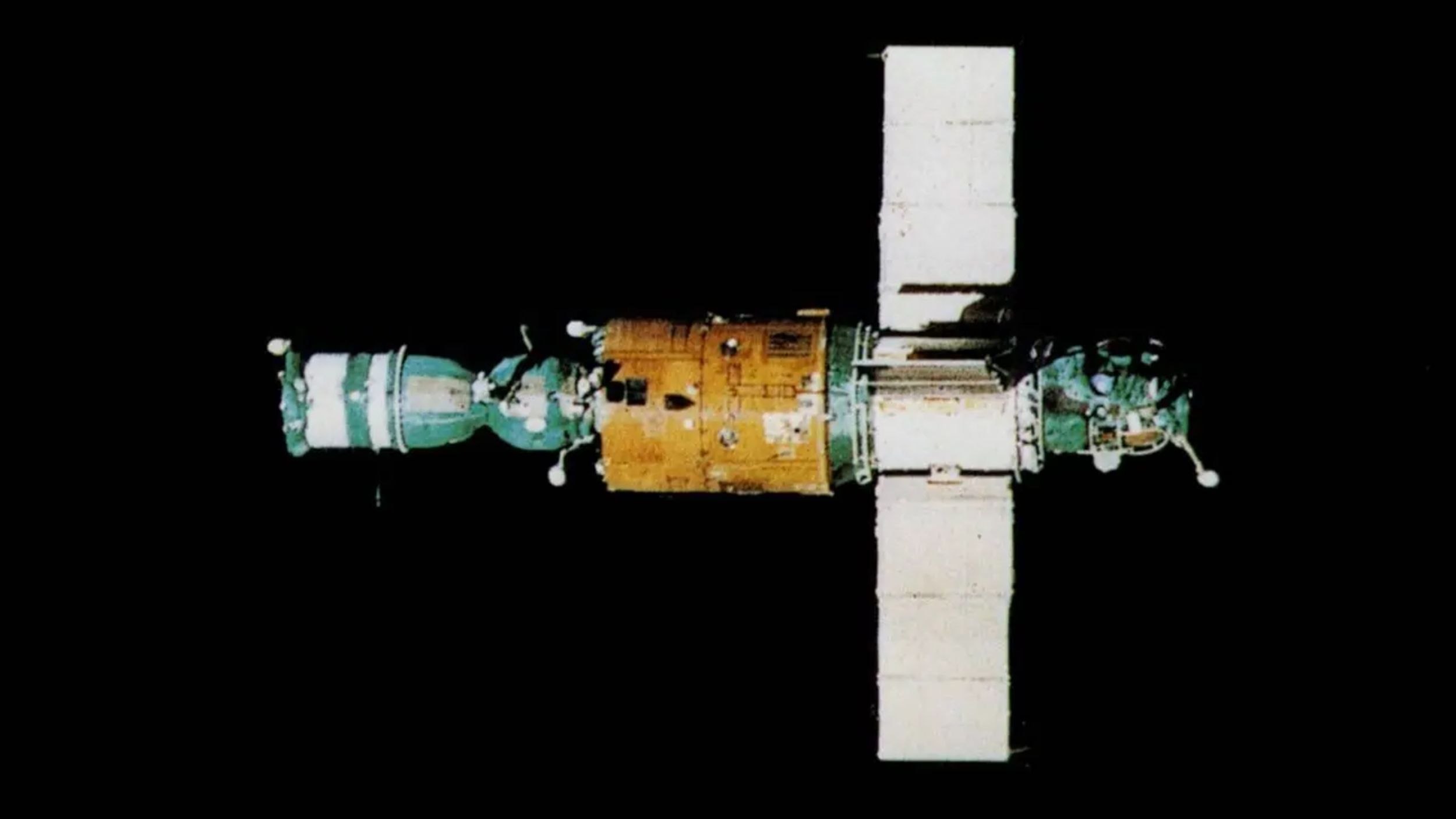
On September 29, 1977, the Soviet Union launched the Salyut 6 space station, marking the eighth space station in its Salyut program. It was the first second-generation Salyut station, specifically designed to support long-duration crewed missions. Salyut 6 was launched into orbit aboard a Proton-K rocket.
Read More
During its five years of operation, the station hosted 16 cosmonaut crews, with the longest mission lasting 185 days. Salyut 6 deorbited in 1982 after re-entering Earth's atmosphere.
Salyut 6 introduced several advancements over its predecessors, such as two docking ports, which allowed for simultaneous presence of a prime crew and visiting automated Progress cargo ships, as well as another Soyuz spacecraft for joint operations. It also featured an airlock for spacewalks, enabling cosmonauts to conduct extravehicular activities more frequently. Throughout its mission, cosmonauts carried out three spacewalks, one each in 1977, 1978, and 1979. The last crew visited Salyut 6 in May 1981.
The decision to end the station's mission in 1982 was reportedly due to a mold problem. Salyut 6 was intentionally deorbited on July 29, 1982. The advancements of Salyut 6 set a new benchmark for the duration of human space missions, influencing the design and operation of the International Space Station, which has hosted missions lasting up to a year since its launch.