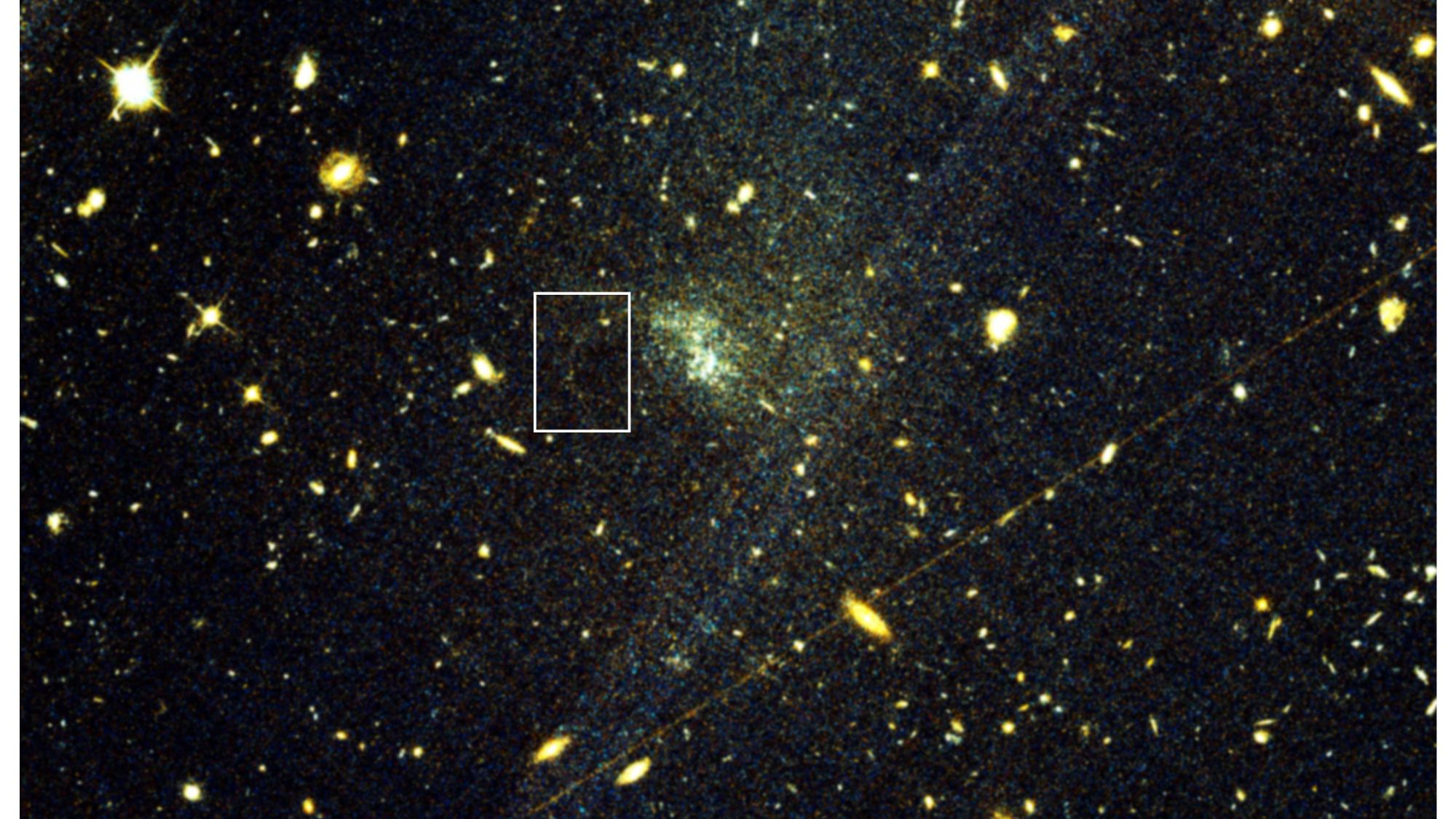
In June 2023, David Hendel, a former astronomer, was commuting on a train in New York City when he came across an image of the dwarf galaxy UGC 9050-Dw1 captured by the Hubble Space Telescope. Located approximately 115 million light-years from Earth, the galaxy appeared as a faint, diffuse smudge of bluish-white light, indicative of an ultra-diffuse galaxy, which predominantly consists of dark matter, a form of matter that remains undetected yet constitutes over 80% of the universe's matter.
Read More
Hendel was particularly intrigued by a fragile ribbon of stars trailing from UGC 9050-Dw1, displaying characteristics of a stellar stream expelled from a globular cluster due to gravitational influences. He recognized these features while scrolling and felt he had made a significant discovery. "It almost seemed too good to be true," Hendel recalled. Realizing the potential implications for dark matter research, he reached out to Sarah Pearson, an associate professor of astrophysics at DTU Space in Denmark, sharing his findings in hopes of further investigation.
This collaborative effort resulted in the confirmation of the stream, named Oyashio, meaning "cold Pacific current" in Japanese, following a naming tradition that honors various Indigenous cultures with historical astronomical practices. While astronomers have identified around 100 stellar stream candidates within the Milky Way, finding one around another galaxy like UGC 9050-Dw1 is notably rare.
The dim nature of UGC 9050-Dw1's stellar population helped in spotting Oyashio, as a less crowded backdrop allowed for better visibility of the stream, according to Julie Kiel Holm from the Niels Bohr Institute. Experts believe examining streams like Oyashio could provide critical insights into the properties of dark matter devoid of interference from other astrophysical factors.
Notable in this context, Emily Cunningham, an assistant professor at Boston University, commented on the importance of such discoveries for future research. Improved observational tools, such as the upcoming Nancy Grace Roman Space Telescope, are expected to enhance the identification of similar faint stellar streams across various galaxies. This research could help clarify dark matter's impacts on stellar distributions.
UGC 9050-Dw1 was first cataloged in 2017 during a survey focused on diffuse dwarf galaxies. A follow-up study in 2023 noted a significant globular cluster population surrounding the galaxy, suggesting its formation from the merger of other galaxies around 10 billion years ago. Despite earlier studies, Oyashio had not been previously identified until Hendel's observation.
Holm's team rigorously analyzed both archival Hubble data and findings from the Canada-France-Hawaii Telescope, successfully confirming Oyashio's existence while ruling out alternative explanations. The research highlights the stream's sensitivity to dark matter's influence, as shifts in the stream could indicate the presence of a smaller dark matter clump impacting its trajectory.
The complexity of the universe’s structure makes it challenging to attribute specific cosmic phenomena to isolated events, necessitating a broader catalog of stellar streams from various galaxies to improve understanding.
The team's findings were published on August 12 in the journal Nature. Hendel's serendipitous discovery underscores the importance of public data access, allowing researchers to investigate existing records for new insights. Sharmila Kuthunur contributed as an independent space journalist on this story.