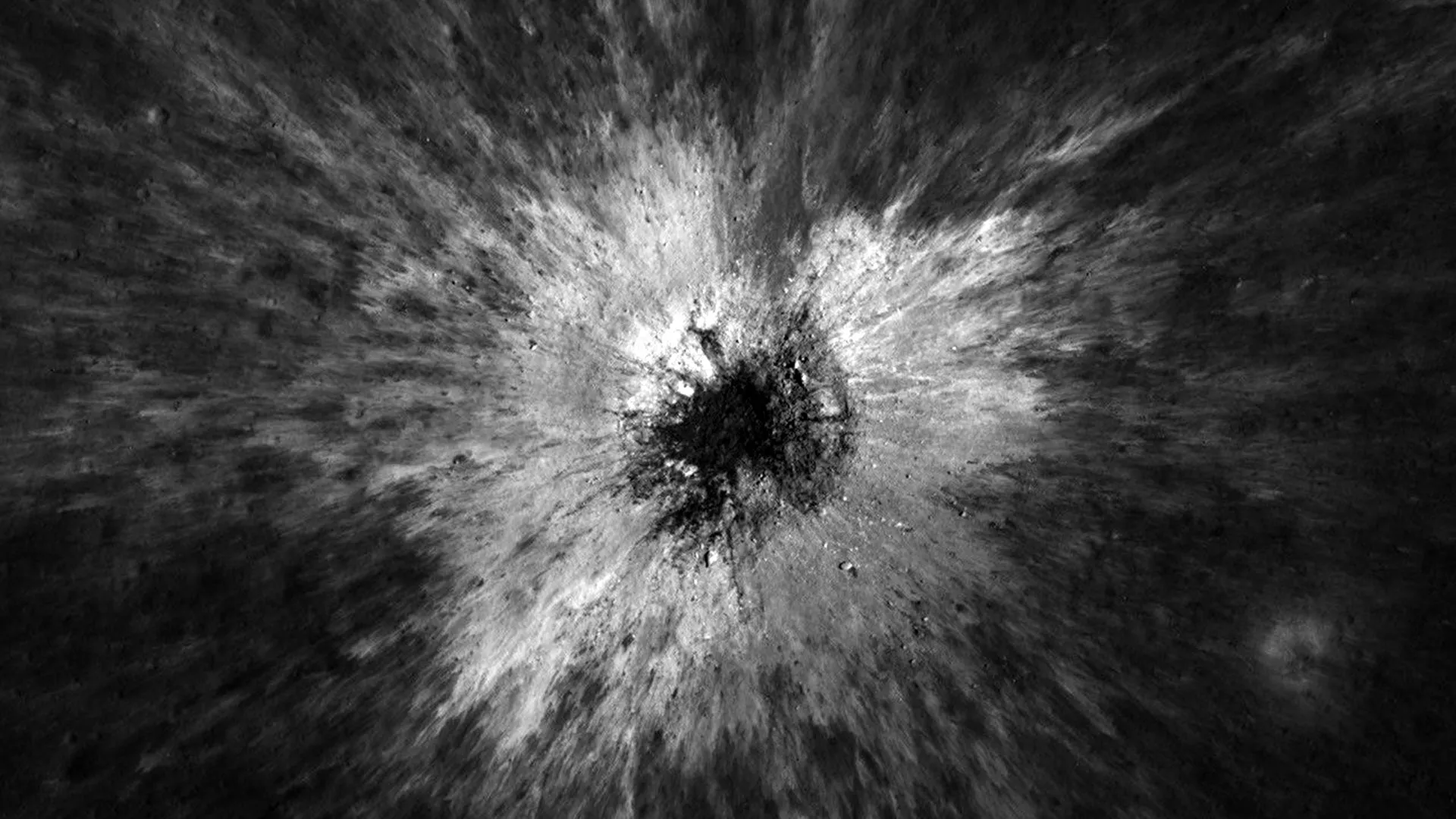
A recent examination of lunar data by NASA has led to the discovery of the largest newly formed crater ever identified in the solar system. Robert Wagner, a scientist working with NASA's Lunar Reconnaissance Orbiter (LRO), noticed an unusually bright area on a lunar map, indicating that the lunar surface had been recently disturbed.
Read More
Wagner, an image-processing specialist from Intuitive Machines, began investigating the bright patch and found that it represented a new impact crater. This finding was reported on September 16 in Science Advances. The crater, named McGetchin in honor of lunar scientist Tom McGetchin, formed between April 11 and May 22, 2024, following a collision with an asteroid or comet about the size of a three- to six-story building.
Measuring 728 feet wide and 141 feet deep, the crater is large enough to fit three stacked yellow school buses. Researchers estimate that impacts of this magnitude occur on the Moon roughly once a century, making the McGetchin crater a rare discovery.
For over 17 years, the LRO has been mapping the Moon, identifying over 1,000 new impact craters and documenting around 100,000 surface changes from impacts. Unlike Earth, the Moon lacks an atmosphere, allowing space rocks to collide directly with the surface. Most of these impacts produce much smaller craters; the LRO can detect features as small as 30 feet across.
Following the identification of McGetchin, scientists utilized the LRO’s thermal instrument, Diviner, to explore the area surrounding the crater. They discovered a cold spot approximately 4 miles in diameter, which is about 16 degrees Fahrenheit colder at night compared to the adjacent lunar landscape. This temperature difference is believed to result from changes in the lunar regolith caused by the impact, which has made the area less dense and less capable of retaining heat.
The finding highlights how significant impacts can alter the Moon’s surface beyond the immediate vicinity of the crater, which might affect future lunar exploration activities.
The LROC system, which photographs the Moon from about 60 miles above, includes cameras designed for high-resolution imaging. On October 24, 2025, while searching for larger features, Wagner identified McGetchin using advanced software to analyze "before" and "after" images. The debris pattern from this crater was notably distinct, marking it as an exceptional discovery among the over 150-foot features.
Following the initial detection, closer observations were made with the Narrow-Angle Camera, which can capture fine details, allowing researchers to better assess the crater's size and the surrounding alterations. Further research on the impact is expected in future publications.