Many moons orbiting the planets Saturn, Uranus, and Neptune are believed to harbor oceans beneath thick icy shells. These hidden oceans are considered some of the most promising locations in the search for extraterrestrial life, as water is essential for life as we know it.
Read More
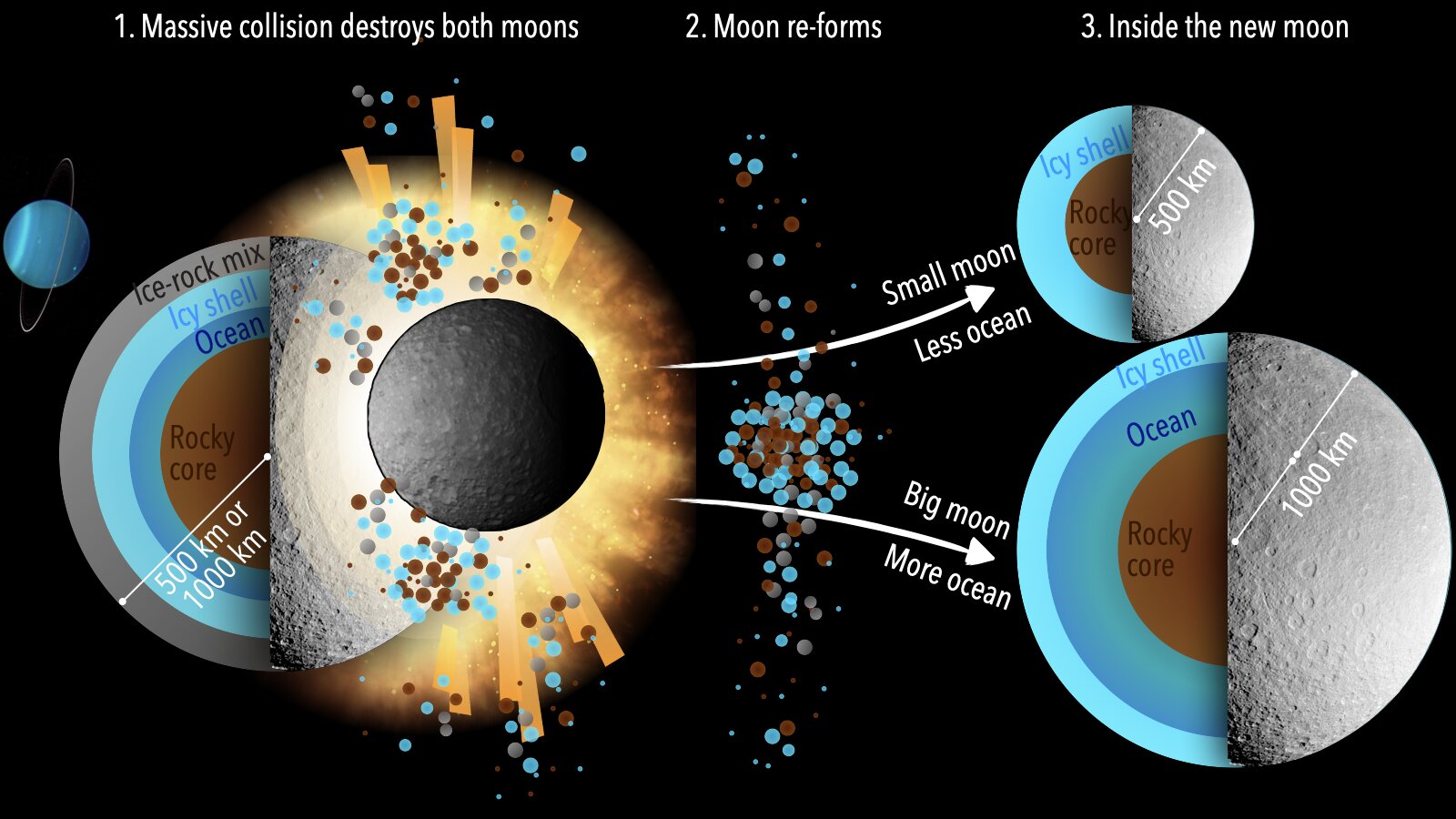
However, the outer solar system is a tumultuous environment with moons that may have been formed through a cycle of destruction and reformation after violent collisions. A key question for scientists is whether these collisions obliterate existing oceans, impacting the potential for life.
A new study led by researchers at the University of Maryland, published in Nature Astronomy, provides insights into this issue. The researchers simulated collisions on icy moons and concluded that even significant impacts do not fundamentally alter the ability of these moons to retain their oceans.
"The big question we asked was whether these destructions help moons have oceans afterward or whether they delete the ocean and reset the moon into a cold, dead world," said Marc Neveu, the study's lead author and an associate research scientist at UMD. The findings suggest that if a moon had an ocean prior to the collision, it likely retains that ocean afterward.
Neveu and his colleagues at the Southwest Research Institute and the Weizmann Institute of Science were surprised by the results. "These simulations were pretty much the biggest collisions we could come up with. If those didn't make a difference, it's unlikely smaller ones would either," he noted.
The research involved combining two distinct types of computer simulations. One focused on the dynamics of cosmic collisions, while the other connected to the long-term thermal evolution of moons. The researchers examined two sizes of moons, approximately 500 and 1,000 kilometers in radius, and found that the size of the moon significantly influences the aftermath of a collision.
For larger moons, the energy from a collision can generate additional heat, potentially thickening an existing ocean. In contrast, smaller moons often have mixed layers of ice and rock that insulate and retain heat. When impacted, this structure is disrupted, making it more challenging for these moons to maintain their oceans, though not impossible.
The implications of this study extend to several real-world targets that NASA and other space agencies plan to explore, including Saturn's moons Mimas, Enceladus, Tethys, Dione, and Rhea, as well as the moons of Uranus and Neptune’s Triton. Rhea, in particular, has drawn interest due to its ancient craters that appear unusually smooth, suggesting the influence of internal heat that could be linked to past collisions.
As NASA considers future missions to study these icy moons, the findings could inform targeting strategies based on the likelihood of ocean presence. This knowledge could affect spacecraft design and detection instruments depending on the anticipated types of life forms.
Neveu emphasized that the collision history is one of many factors influencing a moon's ability to host life, alongside aspects like tidal heating. He expressed interest in further studying the dynamics of moon systems and their evolutionary trajectories to better understand the celestial environments surrounding Saturn, Uranus, and Neptune.