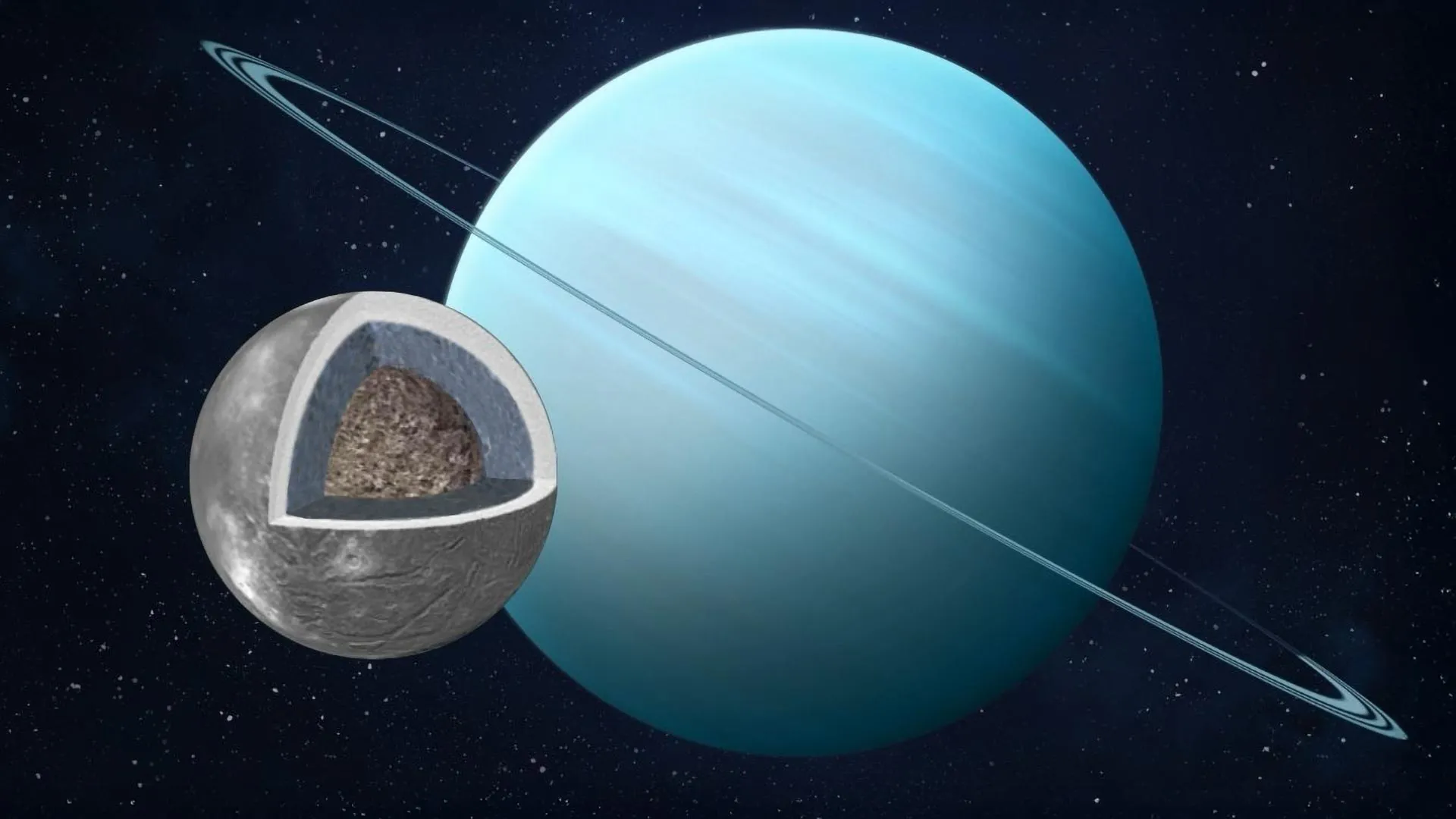
New research indicates that Ariel, a moon of Uranus, may have once harbored a vast ocean beneath its icy surface. A study published in the journal Icarus explores this hidden ocean’s possible evolution and suggests it could have been over 100 miles (170 kilometers) deep, significantly deeper than the Pacific Ocean's average of about 2.5 miles (4 kilometers).
Read More
Ariel is noted as Uranus' brightest and second closest moon, measuring 720 miles (1,159 km) in diameter, making it the fourth-largest moon in the Uranian system. Despite its small size, Ariel possesses a remarkably complex surface featuring ancient impact craters and smoother regions likely formed through cryovolcanism, where ice or water erupts instead of molten rock.
The moon's surface is also marked by extensive fractures, ridges, and grabens, which are subsided areas of the crust. These striking features prompted researchers to investigate Ariel's internal structure and orbital characteristics to explain the formation of the visible fractures.
Central to their study was the concept of orbital eccentricity, which measures how elliptical an orbit is. The researchers found that Ariel may have had an orbital eccentricity approximately 40 times greater than its current value of around 0.001. Although this would still result in a nearly circular orbit, the increased eccentricity would have intensified tidal forces acting on Ariel, potentially causing significant stress on its icy crust and leading to large fractures.
To analyze this, the team mapped Ariel's surface structures and utilized computer models to calculate tidal stresses resulting from changes in its shape during its orbit around Uranus. They concluded that both a substantial ocean and elevated orbital eccentricity could explain the moon’s dramatic geological features.
This study is part of a broader series investigating the moons of Uranus. Previous findings on Miranda, another of Uranus' moons, suggest the possibility that multiple moons within the Uranian system may conceal extensive subsurface oceans. Tom Nordheim, a coauthor and principal investigator of the NASA-funded study, highlighted the need for further exploration of both Ariel and Miranda to confirm these findings.
Ultimately, while the exact timeline for Ariel's hidden ocean remains uncertain, the research provides crucial insights for future missions to investigate how subsurface oceans may form and evolve on icy celestial bodies. A future spacecraft mission aimed at Uranus could further test these predictions by examining the unexplored northern hemispheres of Ariel and Miranda.