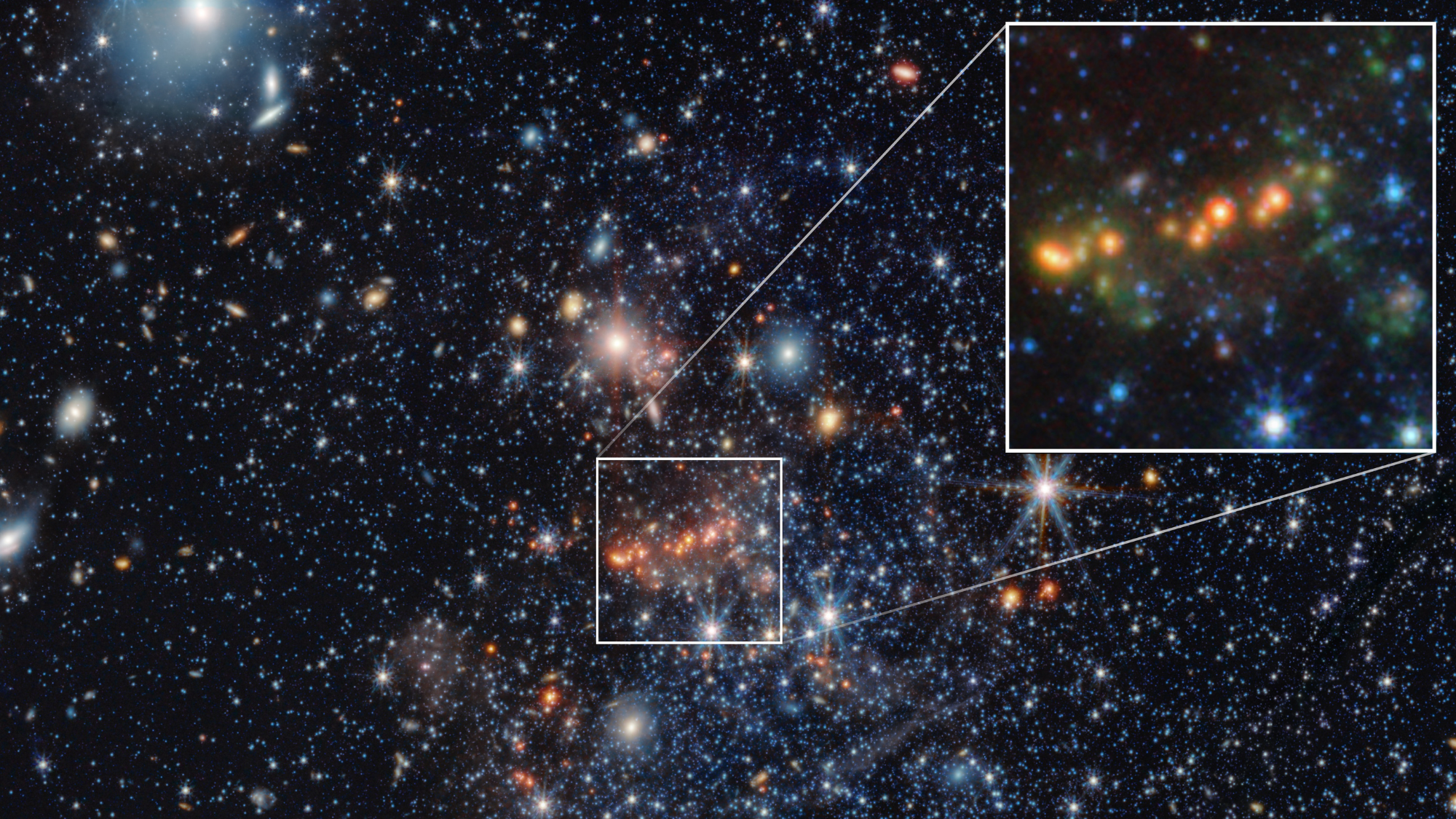
Astronomers using the James Webb Space Telescope (JWST) have gained new insights into early galaxies responsible for enriching the universe with dust essential for star formation and galaxy evolution. While the JWST can observe these ancient galaxies, its capacity for detailed analysis is limited. To circumvent this challenge, researchers studied a nearby dwarf galaxy, Sextans A, located 4.6 million light-years away, which shares similar chemical traits with the universe's first galaxies.
Read More
Claudio Gavetti from the National Institute for Astrophysics (INAF), the research team leader, noted that observing this local galaxy provides an invaluable chance to understand the evolution of the first stars and their contribution to the interstellar medium. The early universe had a simplistic chemical composition dominated by hydrogen and helium, with very few heavy elements, making the first stars, known as Population III (POP III) stars, metal-poor.
As these early stars lived and died in supernova explosions, they spread heavier elements into space, seeding the cosmos for the subsequent generation of stars, or Population II (POP II) stars, which were richer in metals. Our sun is categorized as a Population I star, denoting an even higher metal content.
Sextans A stands out for its low metallicity, harboring only 1% to 7% of the heavy elements found in the sun. This trait makes it an excellent subject for studying metal-poor galaxies. Through JWST's NIRCam and MIRI instruments, the team conducted high-resolution observations of Sextans A during a stellar evolutionary phase known as the asymptotic red giant branch, where stars expand significantly after exhausting helium in their cores.
Their findings revealed that approximately 90% of the observed stars in this phase lacked dust envelopes, but around 20 stars were found encased in thick dust shells. These dust-producing stars formed between 2 billion and 3 billion years ago and had initial masses about 1.5 times that of the sun. This research enhances understanding of which stars contributed to cosmic dust enrichment in subsequent generations.
The study's authors assert that such investigations were previously unfeasible prior to the JWST's launch. Flavia Dell'Agli of INAF emphasized the extraordinary detail the JWST allows researchers to observe and the importance of correlating these observations with theoretical models regarding stellar evolution. The research findings were published on July 20 in The Astrophysical Journal.