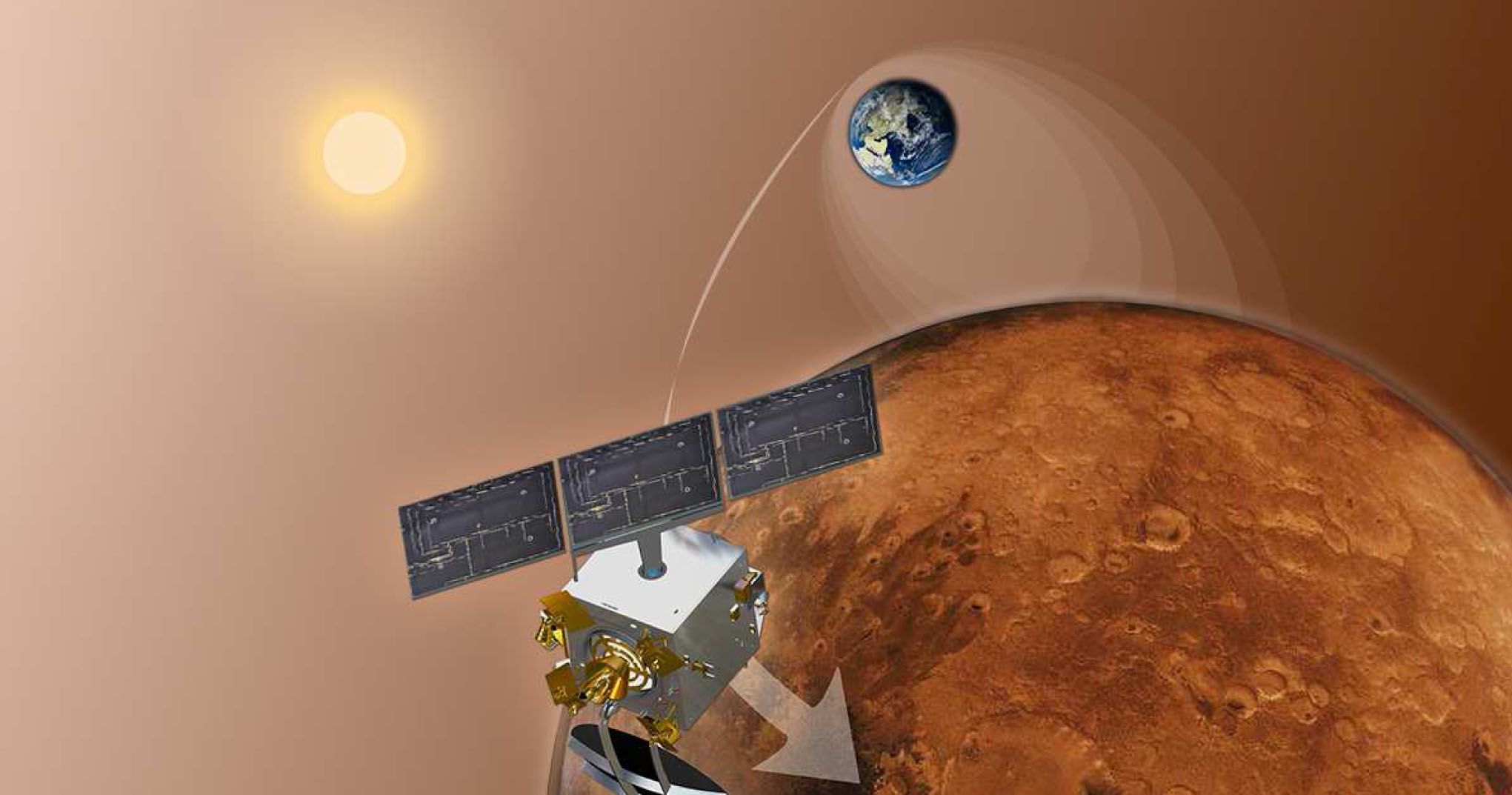
On September 24, 2014, India's Mars Orbiter Mission (MOM), also known as Mangalyaan, successfully entered orbit around Mars. Launched by the Indian Space Research Organisation (ISRO) on November 5, 2013, Mangalyaan represented India’s first interplanetary mission, designed mainly to demonstrate the country's capability to send a spacecraft to Mars.
Read More
After a 10-month journey, the $74 million mission brought advanced scientific instruments and cameras to study the Martian atmosphere and capture images of the planet. Initially intended to operate for 10 months, Mangalyaan exceeded expectations, conducting scientific operations until October 2022.
Upon reaching Mars, Mangalyaan executed an elliptical orbit that varied in altitude from as low as 227 miles (365 kilometers) to as far as 49,710 miles (80,000 kilometers), completing an orbit every 77 hours. With its success, India became the fourth country to successfully place a spacecraft in Martian orbit, following the United States, Russia, and the European Space Agency; the United Arab Emirates and China achieved similar milestones later in 2021.
Mangalyaan was notable for its low budget compared to other missions, such as NASA's MAVEN Mars orbiter, which cost approximately $671 million at launch. The mission's significance was such that in 2016, India honored Mangalyaan by featuring it on a 2000-rupee banknote.
Over eight years in orbit, the orbiter provided critical data using its instruments, including a color camera, thermal infrared sensor, ultraviolet spectrometer, and mass spectrometer. Contact with Mangalyaan was lost in October 2022, likely due to a depletion of fuel necessary to keep its solar arrays oriented towards the sun. ISRO officials remarked that the mission would be remembered as a remarkable achievement in planetary exploration.